Parts Department

We Make Stuff

Black

Parts Department: We Make Stuff

9 May, 2026

Words by:

Cobey Bartels

In a non-descript shed in Brisbane’s inner north, Sam Stewart and Dugald Moncrieff have spent four years turning Parts Department into something the public art world hasn’t quite figured out how to categorise.

The door to the Parts Department meeting room, at the back of the studio space, has its handle in the wrong place. Or, depending on how you look at it, the right place. It sits low, near the bottom of the door, around hip height, exactly where your hand is when you reach it.  

“That’s some industrial design shit,” Stewart laughs, watching me grasp it awkwardly. “Why do we raise our hand to open a door? The handle should be where your hand already is.”

I open and close it a couple of times, and it starts to make sense. The handle is heavy and requires a deliberate input, but its position is inviting. It’s mounted to a door made of recycled glass, which the guys salvaged from a West End high-rise that didn’t pass certification. 

The walls of the workshop are the cheapest construction material you can buy – nine-millimetre OSB sheets, left raw and unfinished, held up by a steel frame that Stewart and Moncrieff welded together themselves. The whole interior fit-out, including the glass partition with its repurposed panels and quietly subversive door, was built by the two of them. 

Parts Department is a workshop run by people who solve problems. Problems like every door handle in the world being in the wrong place. 

Stewart and Moncrieff run Parts Department out of the light industrial suburb of Geebung in Brisbane, surrounded by panel beaters, truck workshops, and signage factories. 

Very much at home surrounded by other people making or fixing things, in a shed with correctly placed door handles, they design and fabricate public art. Sometimes they are the artists themselves. But, more often, they are the people who turn other artists’ visions into objects you can stand next to. 
Both are industrial designers by training. They met at university, kept in touch through the long, branching apprenticeships that designers tend to wander into, and started Parts Department around the end of 2021. 

Moncrieff had spent close to a decade running FE Fabrication, a custom fab shop in inner Brisbane, and still contracts back there every so often. It was there he learnt to weld up his CAD designs, turning sheets of stainless steel into usable items. He’d design, fabricate and install intricate beer tap fitouts, custom furniture, and insane one-off motorcycles like a standing chariot pulled by two postie bikes. 

Meanwhile, Stewart has the portfolio of a creative who can’t stop starting things: graphic design, a leatherwork business, singwriting for cafes and bars, a research stint at a university, and a long stretch during COVID redesigning Queensland Rail’s southeast network maps. All of this – plus a bunch of other creative endeavours he probably isn’t telling me about – has resulted in a truly eclectic skillset. 

“No one in industrial design goes home and watches TV,” Stewart says, justifying his countless endeavours. “You meet most industrial designers, everyone’s got the same sort of thing. Everyone needs a project – always. I think my problem is I need three.”

What’s interesting is not that two industrial designers have started a workshop together. What’s interesting is what they’re doing inside it, and how an unusual array of shared skills have made it possible. 
Public art is a misunderstood scene, where the artist is the frontman and the installation studios are the backing band. In Australia, there are a few big players that design and build art installations, and they’re fairly corporate. 

That isn’t what Stewart and Moncrieff wanted to be. There’s an anti-corporate attitude to this place. Picture a design studio with artists from every conceivable discipline, and no real rules – that’s what it feels like.

When the time came to choose a real name for the studio, the pair wanted something ambiguous enough that it couldn’t be confused with anything else. Parts Department was perfect because, as Stewart puts it, “it sounds like we make car parts, or, you know, anything else really. It was suitably vague.” 

The tagline they later landed on – “we make stuff for people that need stuff made” – performs a similar function. It feels a bit like deflection. Like the pair don’t want to overcommit to doing too much actual work. But, it’s actually quite a precise description and, more importantly, one that doesn’t limit the scope of their work. 

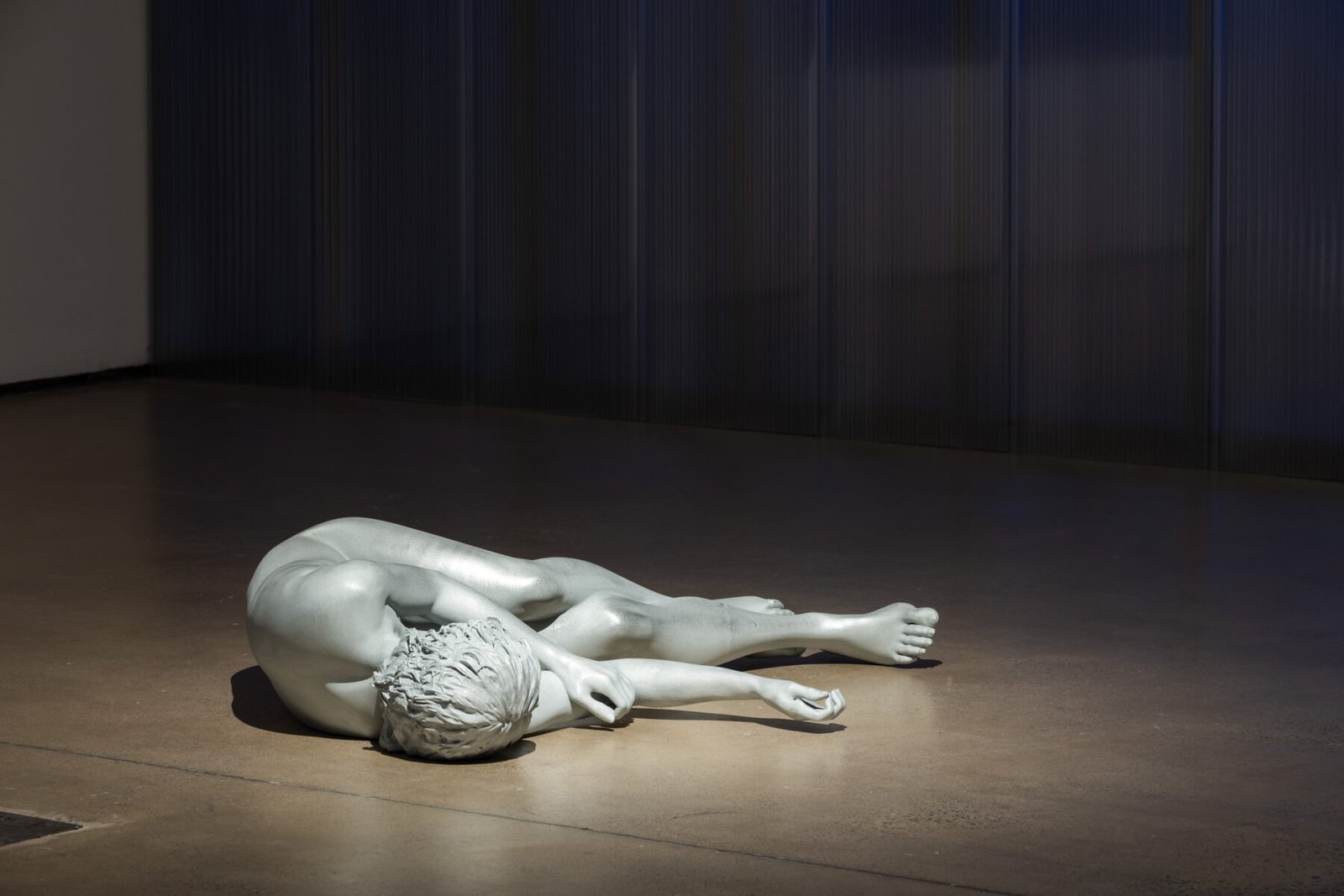
That work, when you start looking at it, is improbably broad. I’m seeing project after project, some startlingly abstract, like disfigured 3D-printed mannequins that crouch like ghouls in a corner of the shed, and others unexpectedly scientific, like the hanging ornaments used to wind-test a larger public art piece that needed to be able to withstand a 188km/h cyclone. 


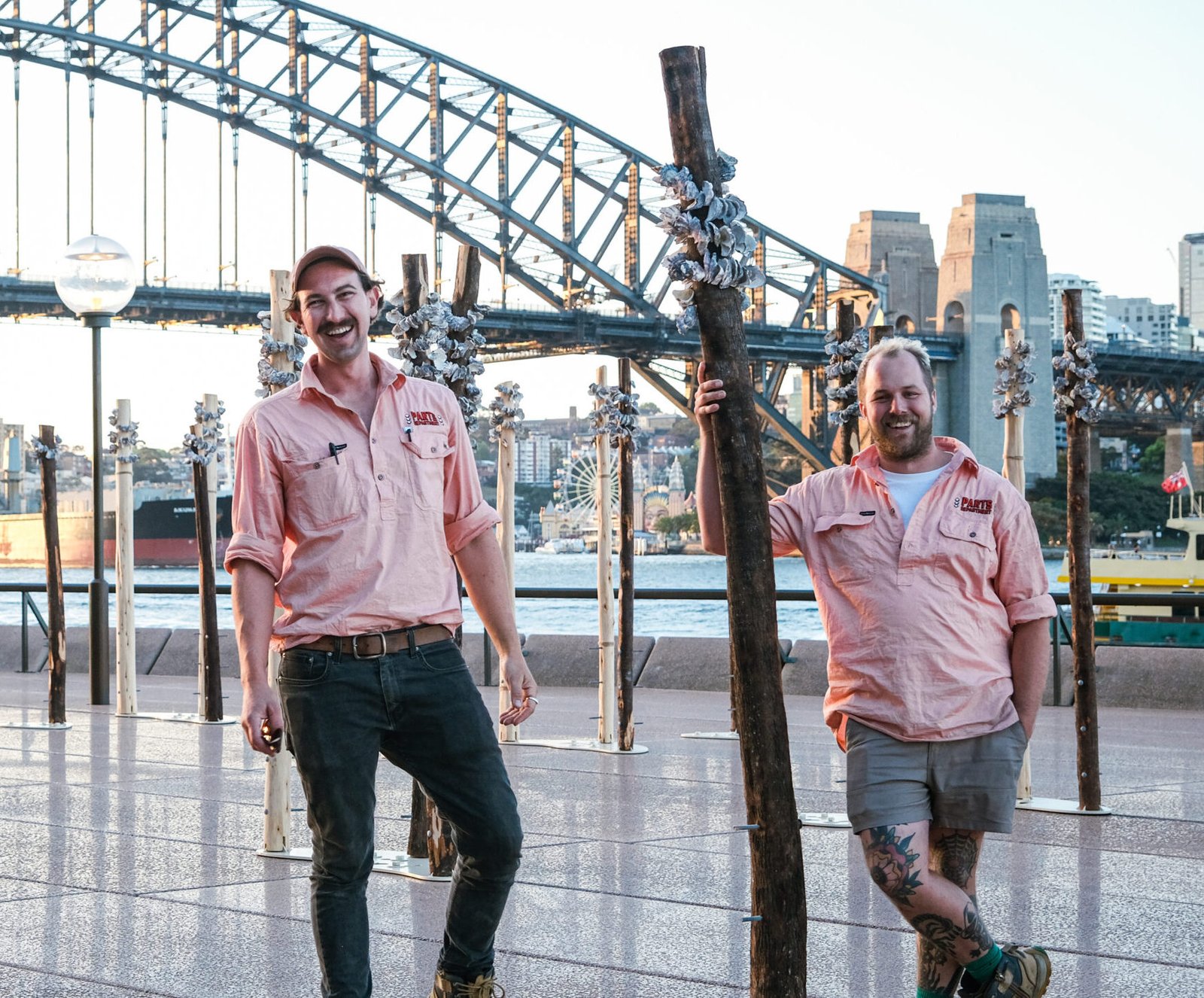
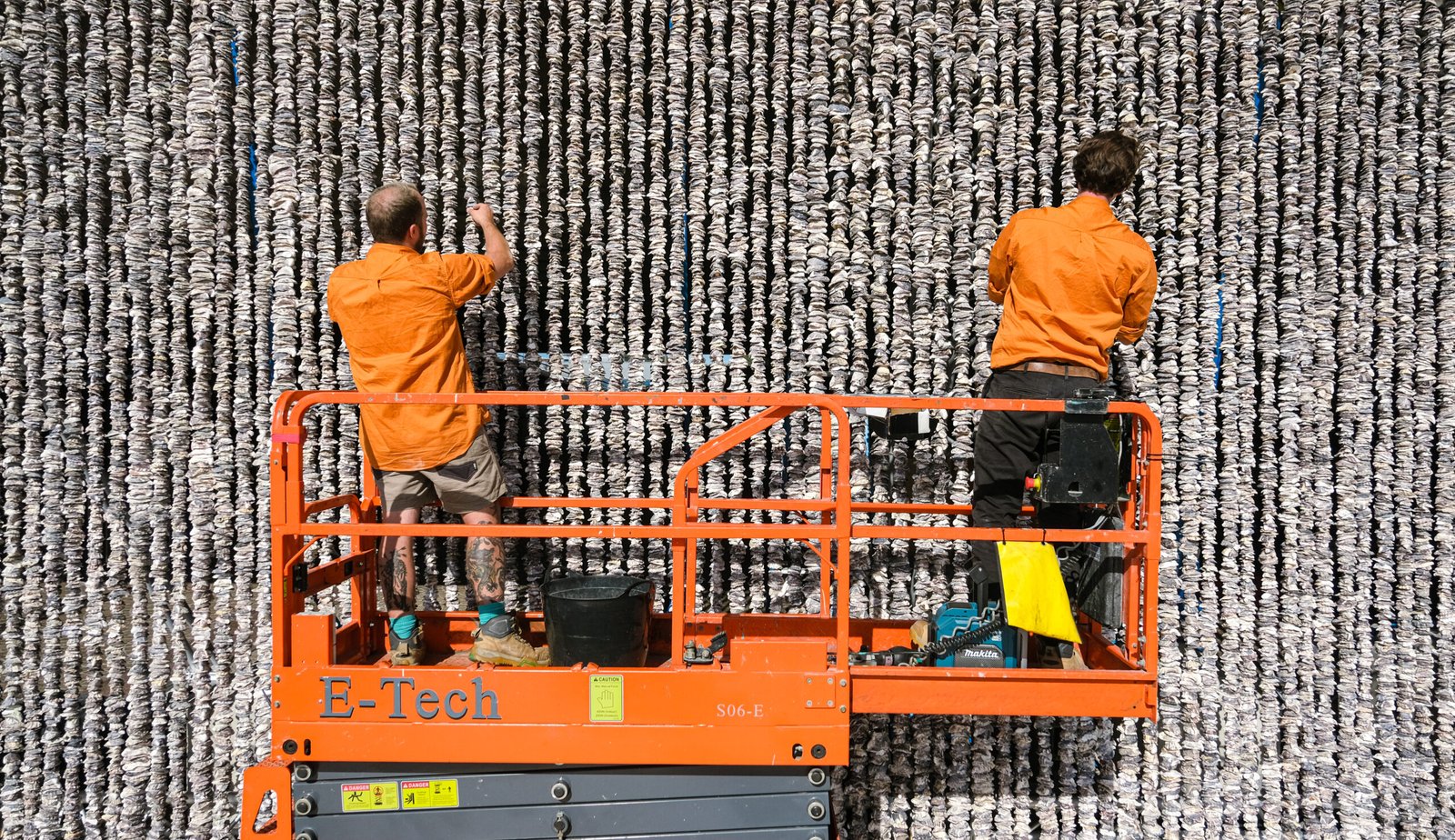
There is Whispers, the monumental installation by Quandamooka artist Megan Cope, sited at the Sydney Opera House for its fiftieth anniversary: two hundred timber poles studded with thousands of cleaned and threaded oyster shells, forming a fourteen-metre wall that emerges through the upper podium. Parts Department fabricated and installed it, working alongside Cope and her gallerist Josh Milani.

Then there is A Simple Story, a stainless-steel scaled-down replica of the Story Bridge by Sam Cranstoun, designed for Brisbane’s 2022 Botanica festival to sit half-submerged in a lagoon in the Botanic Gardens. It was their first project as Parts Department. The bridge changed colour at night, mirroring the lighting of the actual bridge a few kilometres east, while slowly disappearing under the water as the festival went on. Stewart shows me a photo of he and Moncrieff installing it, up to their necks in water. “Lots of eels ,” he says. “There were so many eels in there.”

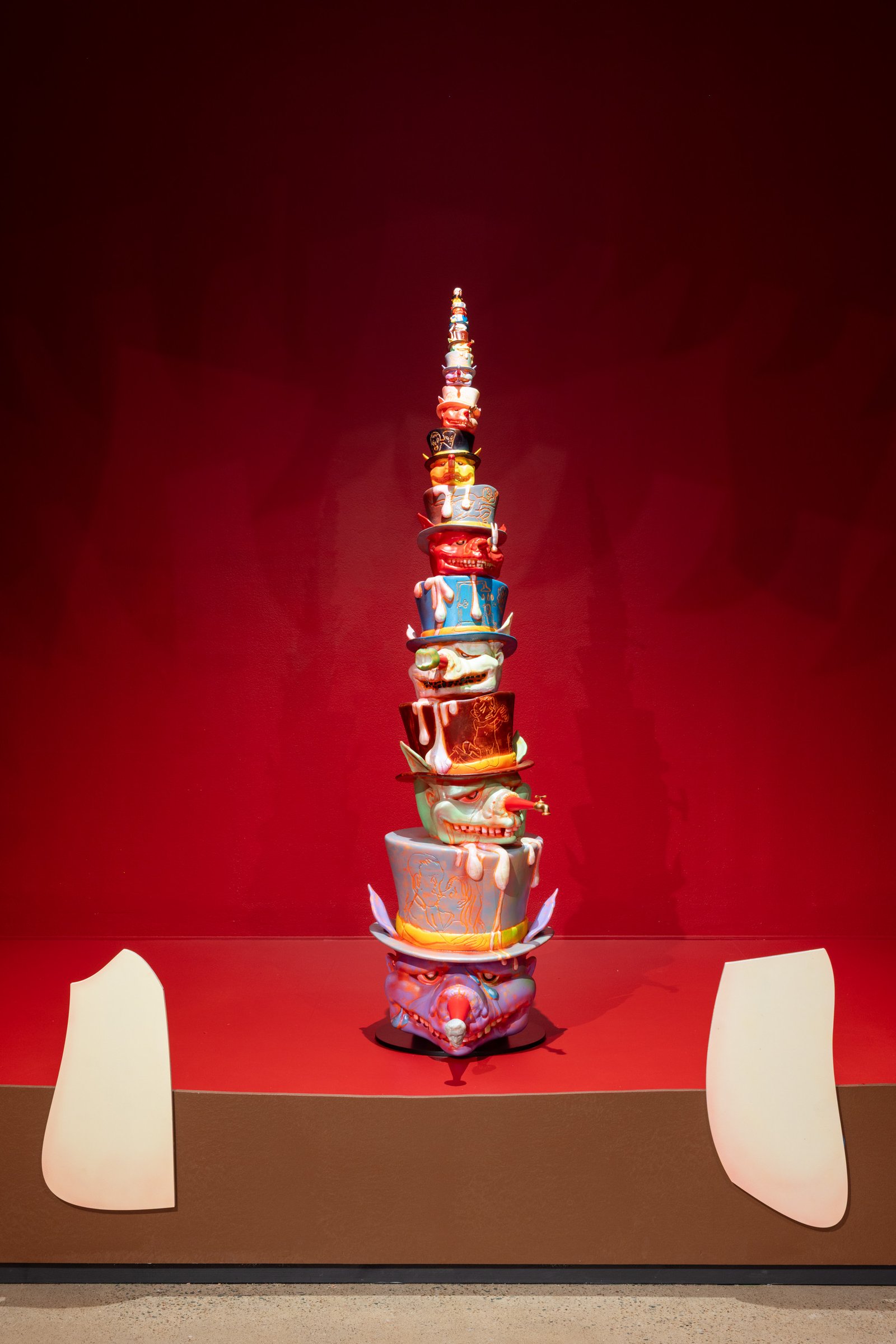
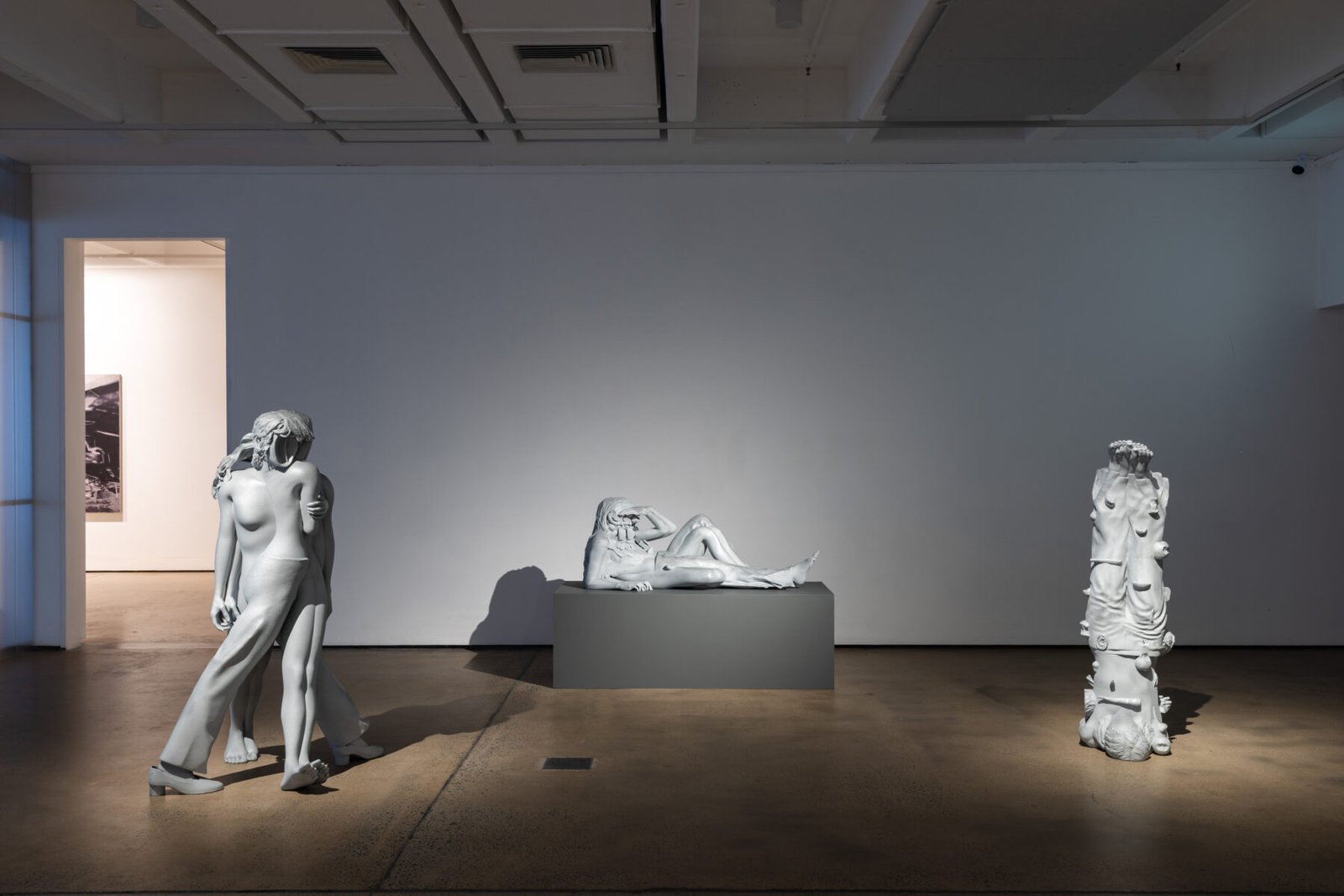
More unusual is Doff-Stack, a 1.8-metre tower of fluorescent rat heads stacked into something that resembles a totem, by the painter Spencer Harvie, currently exhibited at the Institute of Modern Art’s Platform 2026. Harvie sent through what Moncrieff describes, admiringly, as a “completely insane drawing” and a digital sculpture model. Parts Department managed the procurement of the 3D-printed components from overseas, which arrived in boxes, and which were routinely held up in customs because, as Stewart points out, a box of 3D-printed body parts looks “pretty cursed on an X-ray.”

Credit: Joseph Ruckli, courtesy of the Institute of Modern Art

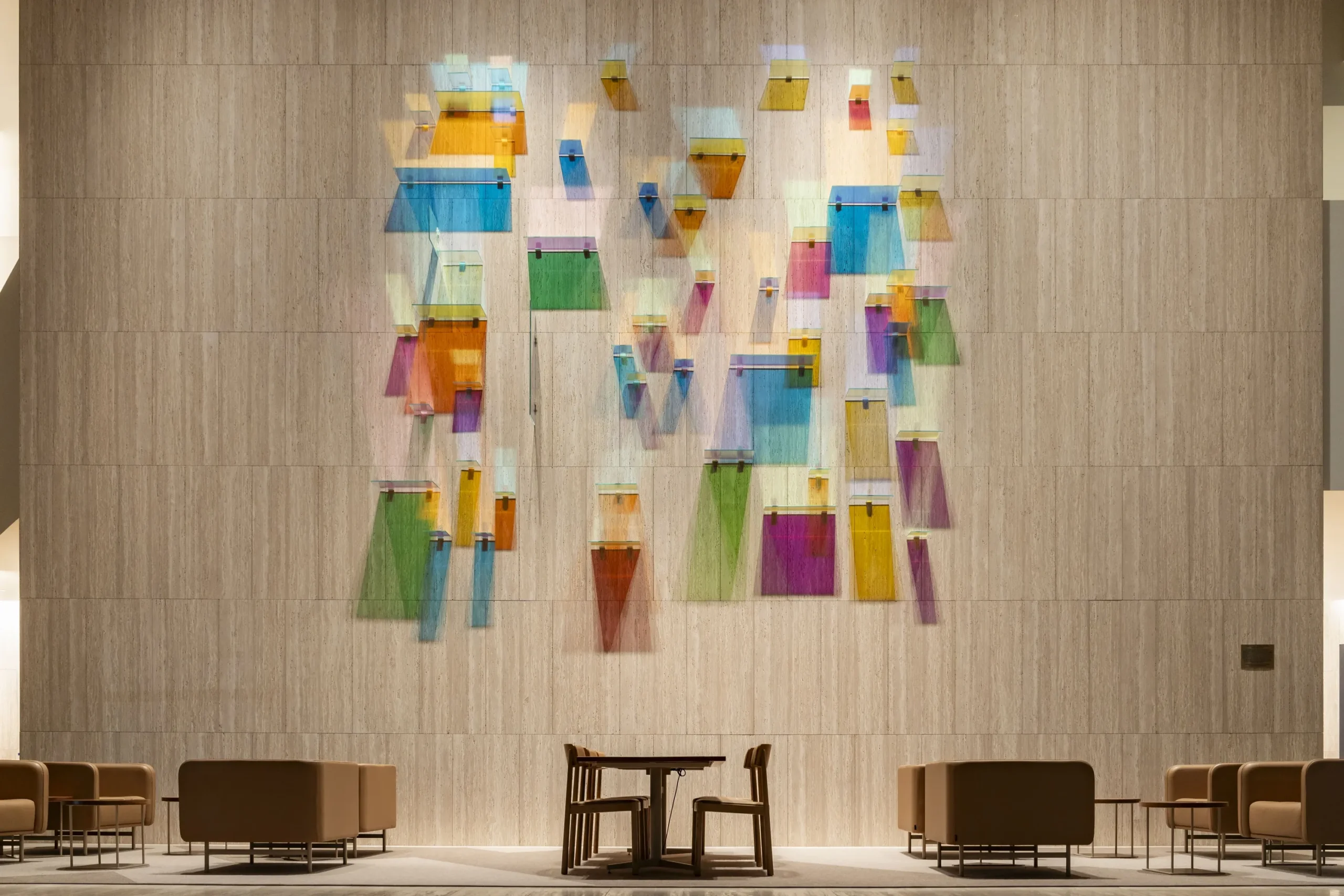
More lasting is Ambient Painting by Ross Manning, a permanent installation of more than fifty panels of dichroic laminated glass mounted along the lobby of 12 Creek Street in the Brisbane CBD; the glass reflects one colour and refracts its opposite, depending on where you’re standing. Stewart and Moncrieff worked with Manning to design and fabricate the mounts for the glass, how and where the panels would be installed, as well as the installation itself. 

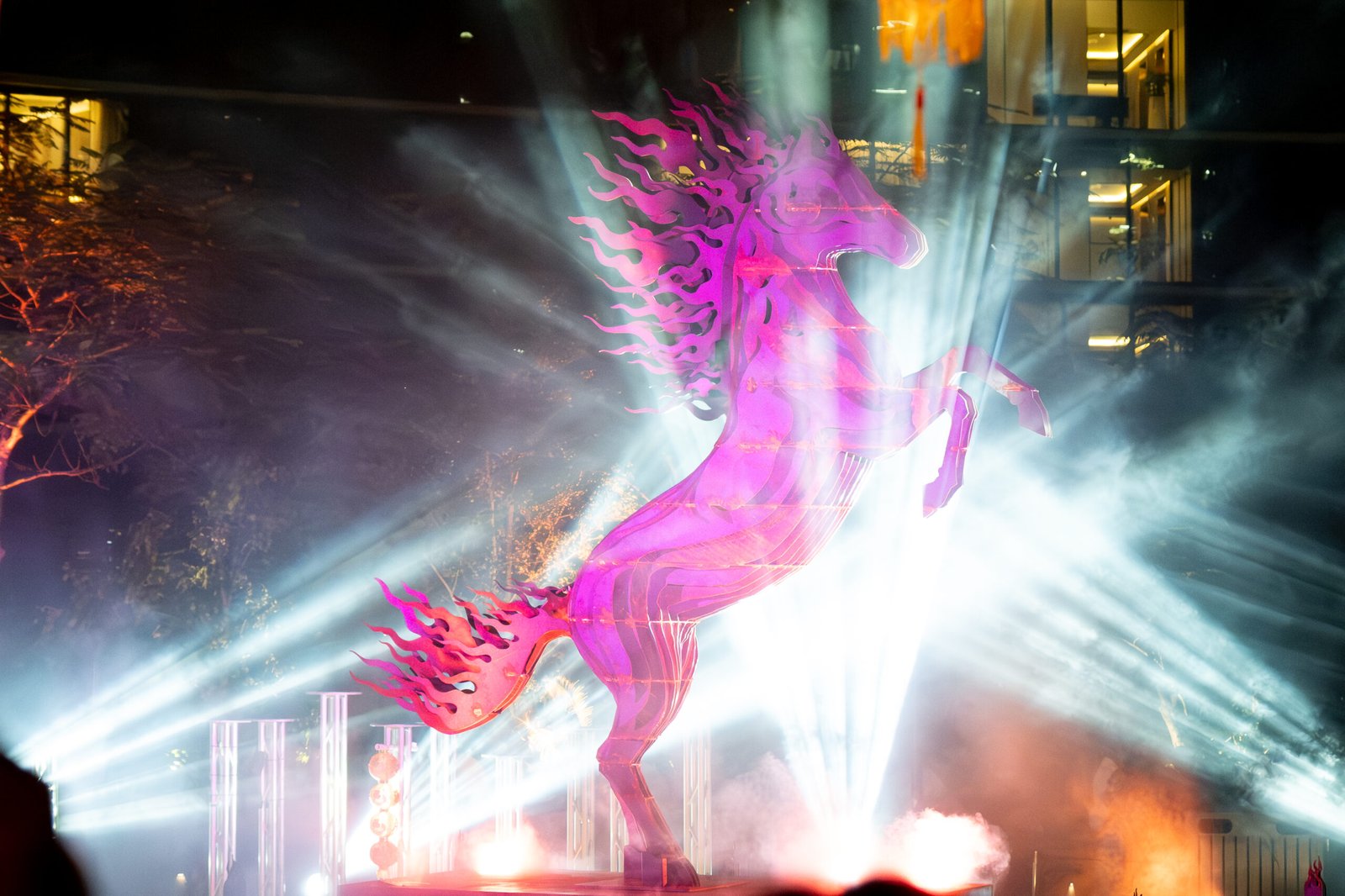
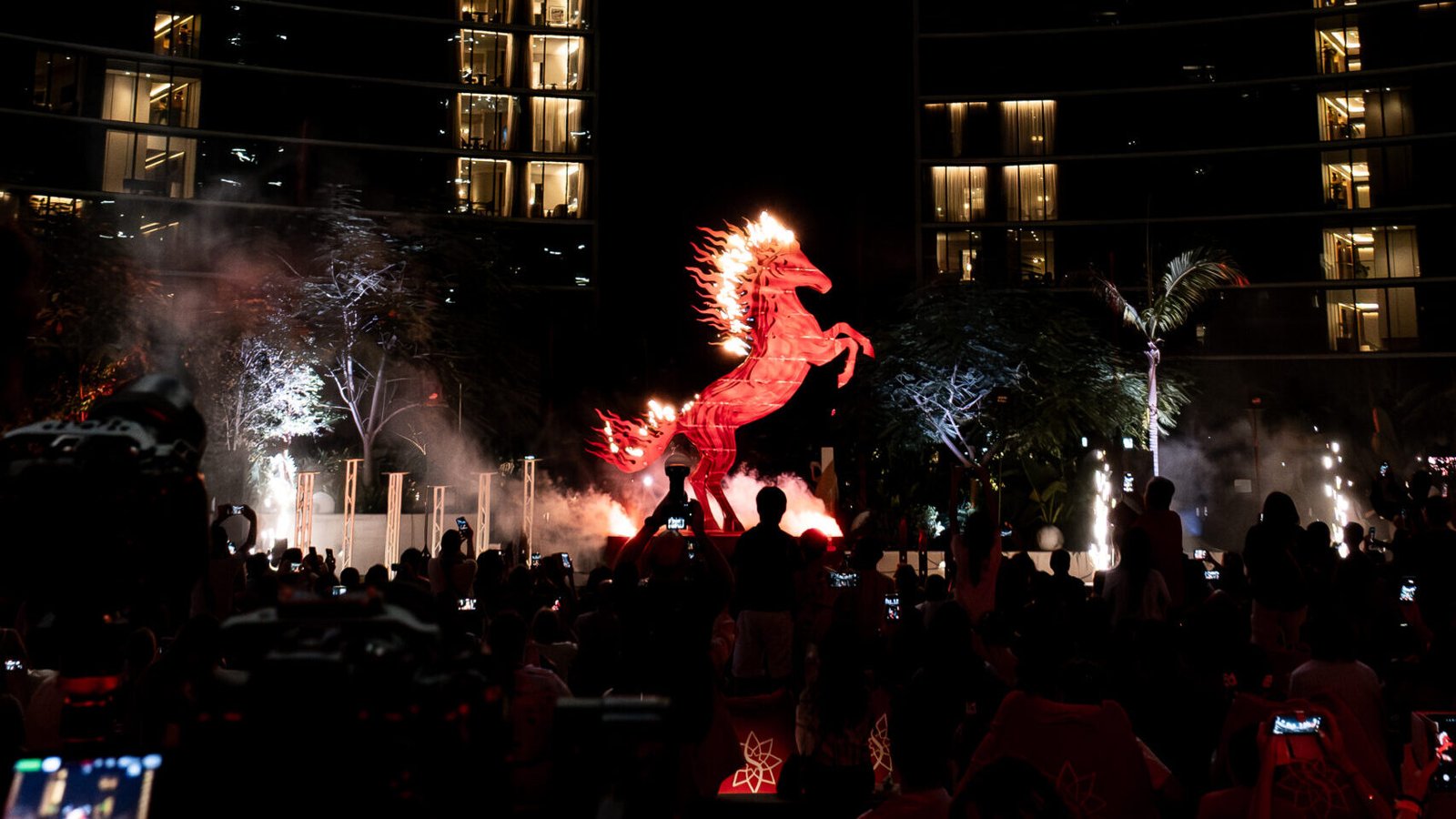
And then there is the Fire Horse, which caught my attention above all else. Perhaps not the most deliberate artistic expression, but certainly the most insane installation yet.

In December 2025, agency Rizer approached Parts Department with an unusual brief, and a seemingly impossible deadline. The Star Brisbane wanted a five-metre-tall steel horse for the upcoming Lunar New Year – the Year of the Fire Horse – installed at Queen’s Wharf, on the seventh floor, that could erupt in flames at intervals throughout the event. The guys had three weeks.

“It was the project where we were the artists,” Moncrieff says. “That made it incredibly exciting, especially given the turnaround.”

There was no external concept holder. The brief was an enormous horse that could shoot fire from wherever the pair saw fit. The rest was theirs to figure out. 

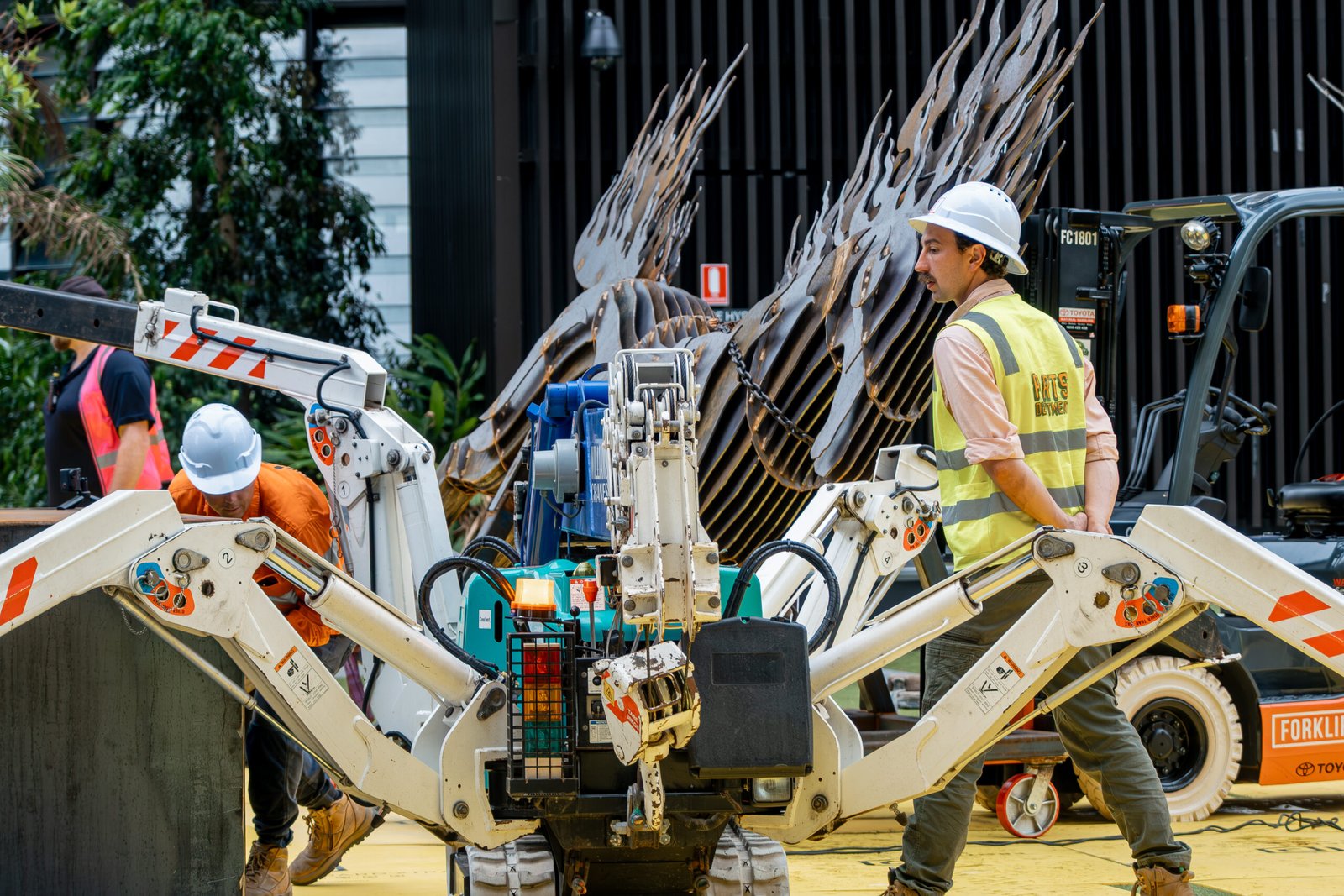
What they built – laser-cut from six-millimetre steel plate, assembled in their workshop using cranes, magnets and fire-test rigs, transported to the seventh floor of a casino on a custom trolley sized down to the millimetre to fit a service elevator, and certified as an outdoor barbecue under the relevant Australian standards because, technically, that’s what it was – became one of the most photographed sculptures in Australia. 

Stewart explains that to make fire erupt from the horse’s mane and tail, they had to run concealed gas lines throughout the sculpture, as well as a pyrotechnic ignition system. “It’s actually no different to any other gas line, really, so we picked up the phone, called a pyro team and got it moving ,” he says. “It’s just a copper line with holes in it, but it’s hidden, and it lights a giant horse on fire.” 

I think they’re both so used to the credit going to artists, they downplay their own genius in each of these installations. Moncrieff is a little more animated than Stewart, but he too seems more eager to see my reaction to the art than to tell me how they constructed it. They’re perfectly suited to being the guys behind the scenes, pulling off the impossible. 

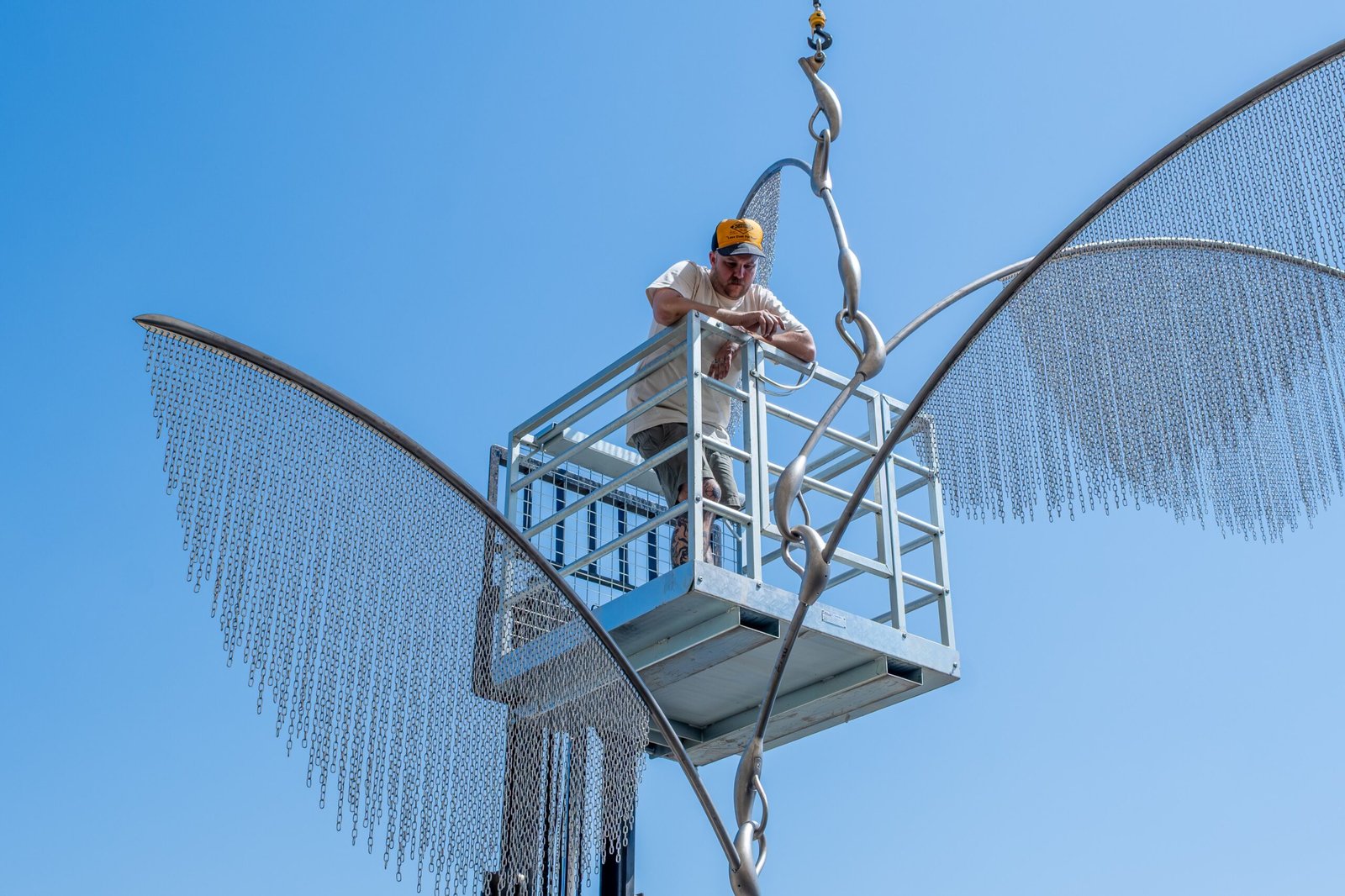
They’ll tell you about something genuinely difficult, like designing a three-storey kinetic mobile made entirely from stainless steel and chain that had to behave structurally as part of the building it hangs from whilst also having to withstand cyclonic winds. And then, almost involuntarily, they’ll downplay their achievement. 

It was just a problem to solve, and they solved it, so why dwell? 

There are half-solved problems throughout the studio. I’m positive both their minds are busily trying to find solutions to those problems throughout our chat, particularly Stewart who fidgets as if multi-tasking would be the better option. And it probably would be, so we wander the studio-come-workshop to look at more of their work. 

Their giant shed functions as a boneyard for the steel mock-ups, 3D printed body parts, timber transportation rigs – all the failed attempts and one-off items that they hold onto, as if quiet reminders of problems solved and the process it took to get there. Or they’re just too busy solving the next problem. 

The eclectic space feels chaotic as an outsider, yet perfectly ordered to Stewart and Moncrieff. It’s an industrial interpretation of a traditional artistic space. There’s paint and sculptures, but also 3D printers and a makeshift wind tunnel.

This is the Parts Department aesthetic, and probably part of the reason artists keep coming back. They can relate, but likely also find it as fascinating as I do. 

The advantage Parts Department has over more established art installation providers is in its deliberately personal approach. By virtue of being large, their competition is unable to offer the thing artists keep telling Stewart and Moncrieff they value most: continuity.

“At these big design companies you deal with a handful of  designers and a revolving door of  project managers,” Moncrieff says. “You go to a company that size, you get lost in the ether. You hand your concept and your soul over and they deliver your sculpture but, like, who even worked on it and how many hands changed it along the way?”

At Parts Department, by contrast, the people who pick up the phone are also the people building the art. Stewart and Moncrieff sit on either side of a table and the decisions get made there. Perhaps that’s reductive, given there are site visits, CAD concepts, procurement and so much more -– but it’s a uniquely personal operation. 

This matters more than it may appear. Public art is collaborative, and it is also vulnerable to mistranslation. Artists arrive with concepts that are sometimes structurally undeliverable. Sometimes the manufacturing realities mean the idea must evolve into something that can actually exist, without losing its meaning. 

Sometimes an access elevator dictates the dimensions before the designer does. Sometimes a council mandates that holes be either bigger or smaller than a child’s finger, or that the work must survive a cyclone. 

The fabricators have to manage all of the things an artist shouldn’t have to – or doesn’t want to. They have to work with an artist, respectfully, as a project evolves. They need to measure emotions and expectations. 

Stewart and Moncrieff are, by both temperament and reputation, very good at measuring. 

“We say we’re going to do it,” Stewart says, “and we do it. And then they ask us to do some more stuff.”


Your next Read

There are few badges in the automotive world that hold as much emotional weight as …

Mitchell’s journey into photography began somewhat serendipitously during high school. “I first used a camera …

A Journey Across Continents Dylan Best’s path into the world of fashion was anything but …

In the early 2000s, the Smart ForTwo was more than just a car—it became a …