Chopard Unveils Mille Miglia GTS Power Control Grigio-Blu 2026 Racing Edition

White

Chopard Distils The Essence Of The Mille Miglia

20 June, 2026

Words by:

Cobey Bartels

Across the classic motorsport landscape, few events possess the elegance, or invoke the romanticism, of the Mille Miglia. Enzo Ferrari famously described it as the most beautiful race in the world, and few could argue with the claim.

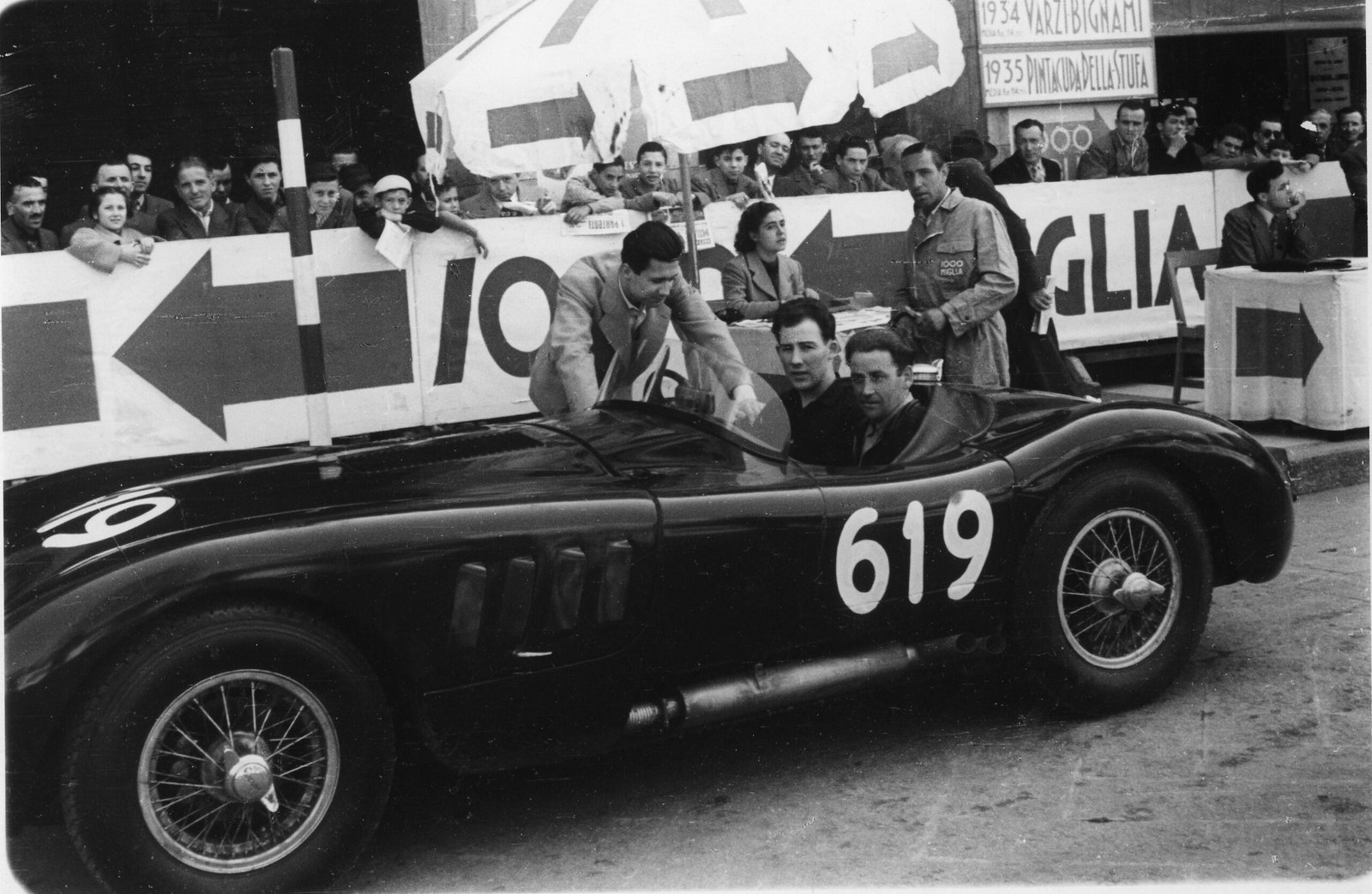
The story of the Mille Miglia (Italian for Thousand Miles) was born in December 1926 amongst a group of friends affectionately known as the ‘Four Musketeers’. Journalist Giovanni Canestrini, Regio Automobil Club secretary Renzo Castagneto, and noblemen Aymo Maggi and Franco Mazzotti dreamed up an open-road endurance race stretching from Brescia to Rome and back. The route covered 1600 kilometres, a distance Mazzotti, who had recently visited the United States, realised was exactly 1000 miles.

The inaugural race took place in 1927 and was an immediate sensation that brought an estimated five million spectators to the roadside. The event saw models from homegrown brands like Alfa Romeo, Ferrari, Maserati and Lancia, as well as internationals like BMW, Mercedes-Benz and Porsche compete at a time when few Italians had seen the exotic metal in the flesh, much less flat-out on public roads.

Despite the variety on the grid, Italian automakers dominated during the event’s formative years. Alfa Romeo claimed 11 victories across the 24 original races, with drivers Nuvolari and Guidotti the first to exceed an average speed of 100 km/h during the 1930 race, aboard an Alfa Romeo 6C 1750 GS. When the race resumed in 1947, after the war, Ferrari landed six consecutive victories, only to have its streak broken by Lancia. 

However, the pursuit of speed, as cars became faster and racers more competitive, ultimately brought the Mille Miglia to an untimely close. In 1956, Stirling Moss set a staggering average speed record of 157.65 km/h behind the wheel of a Mercedes-Benz 300SLR, which the Italian Government criticised as dangerous. Two fatal crashes the following year led to them banning all motor racing on public roads.

Thankfully, the event was reborn in 1977 after a 20-year hiatus, this time as a regularity race for classic and vintage cars. In keeping with heritage, the race was limited to models produced no later than 1957, which had attended or been registered for the original competition. The race remains a global spectacle today, attracting motorsport fans and racers the world over.
Watchmaking and motorsport share a fundamental obsession with mechanics, precision, and time, and for Chopard the two worlds are inextricably linked.

The Swiss watchmaker has served as the World Sponsor and Official Timekeeper of the event since 1988, unveiling a Mille Miglia Edition each year to celebrate the spectacle. In fact, its Co-President Karl-Friedrich Scheufele has actually participated in the race every year since 1989. 

This collaboration extends to Chopard’s family of motorsport ambassadors, including six-time Le Mans winner Jacky Ickx, who has has driven alongside Scheufele in the Mille Miglia for decades.

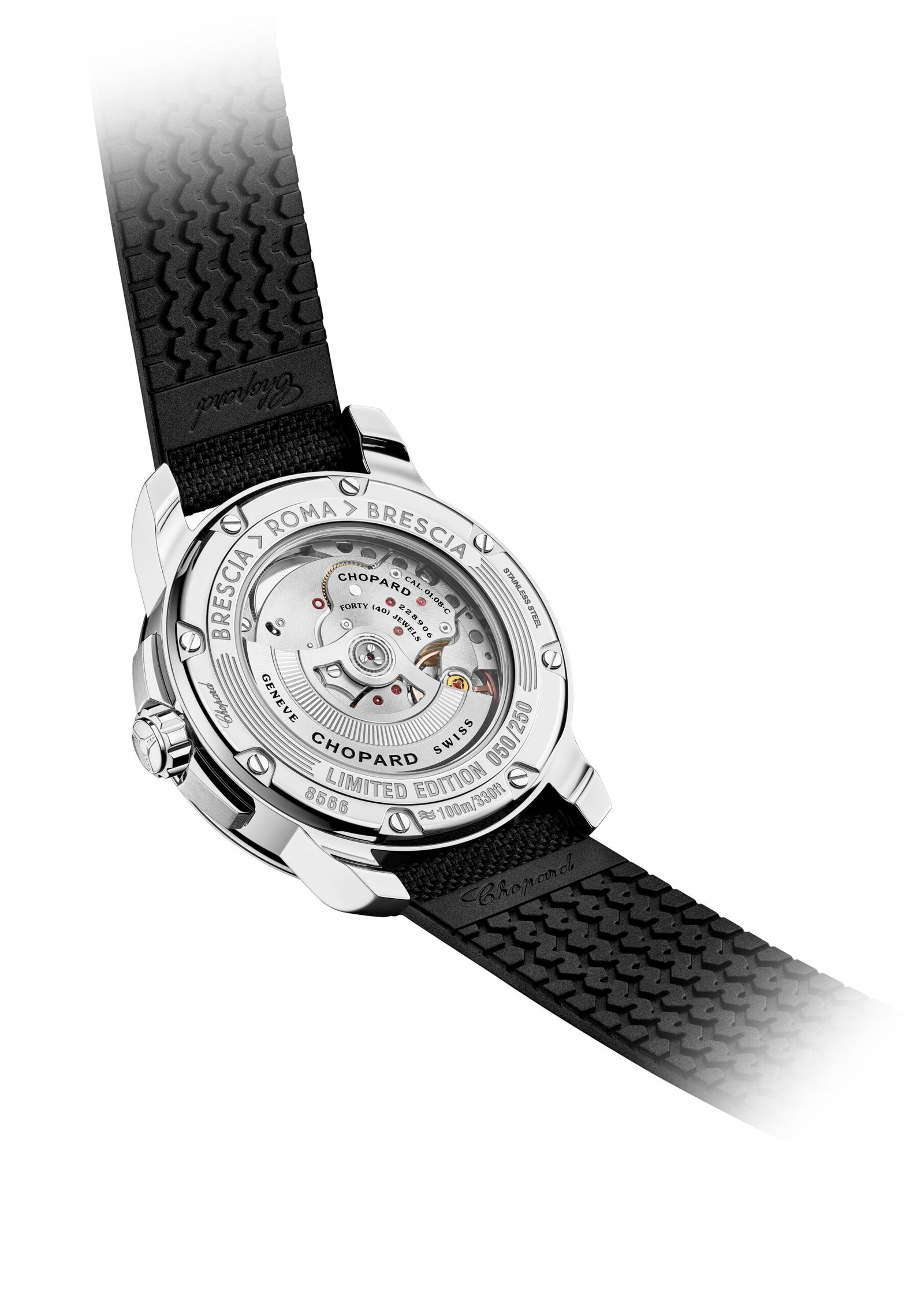
To celebrate this enduring connection to the race, Chopard unveiled the Mille Miglia GTS Power Control Grigio-Blu 2026 Racing Edition at this year’s event. Limited to a numbered edition of just 250 pieces, the timepiece is a contemporary chronometer anchored in the heritage of the race itself.

It features a 43 mm case crafted from Chopard’s proprietary Lucent Steel, which was introduced in 2019 and is produced with an 80 percent recycling rate. An advanced remelting process yields a material with a brilliance comparable to gold, hypoallergenic properties similar to surgical steel, and exceptional abrasion resistance. 

The robust case is balanced by short, ergonomic lugs for a comfortable fit and is water-resistant to 100 metres, including a screw-down crown engraved with a steering wheel motif, reinforcing its identity as a performance-focused instrument for drivers.

Aesthetically, the timepiece draws direct inspiration from the dashboard instrumentation of classic racing cars. The Grigio-Blu dial is crafted from brass and features a grained blue-grey finish that resembles the texture of asphalt. 

Broad, masculine typography offers clarity, while the power-reserve indicator is cleverly designed to resemble an historic fuel gauge. The broad facetted hands and applied metallic hour-markers are coated with black Super-LumiNova, alongside a semi-instantaneous date window, guaranteeing readability in all lighting conditions and, we suspect, at all speeds. 

Beneath the dial beats the Chopard calibre 01.08-C mechanical selfwinding movement, which operates at a frequency of 4Hz and offers a comfortable 60-hour power reserve. It also features a stop-seconds function for accurate time-setting and is chronometer-certified by the Swiss Official Chronometer Testing Institute (COSC).

The racing theme is rounded out by a black textile strap, which is embossed with a subtle tyre tread motif and secured by a Lucent Steel folding clasp.

It’s a watch designed for those who appreciate the romance of the open road and the rigour of fine watchmaking, which can, in this instance, be enjoyed together. 

Your next Read

The most important thing about luxury, I’ve come to think, is in the detail. The …

January in Tamworth is always a gamble. The heat hangs heavy. Car doors sear your …

In a city like Melbourne, where heritage facades butt up against concrete ambition and pocket …

Aston Martin has unveiled its most audacious road car yet, with the hyper-exclusive Valiant, but …