Resurfacing

The reclamation of Deena Lynch

White

Resurfacing: The reclamation of Deena Lynch

12 April, 2026

Words by:

Cobey Bartels

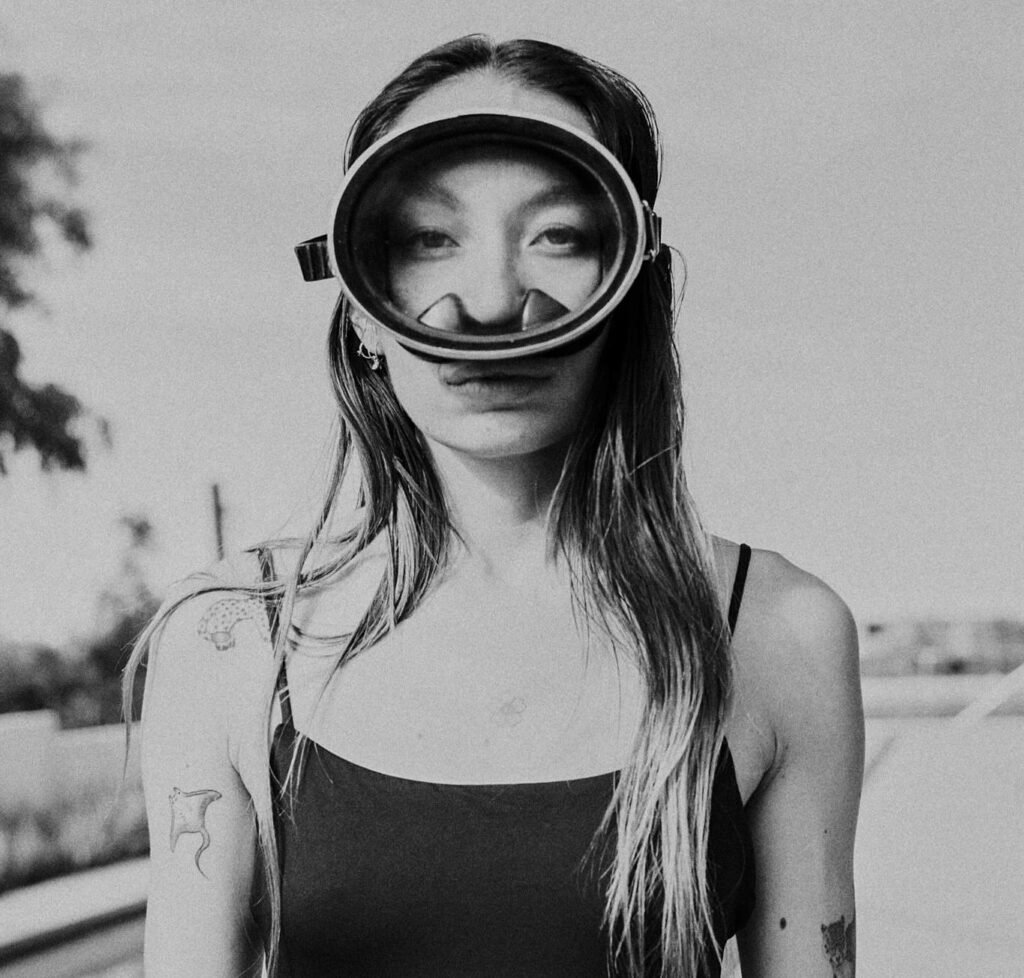
Cobey Bartels talks with Deena Lynch in Bali, where the frontwoman of alt-rock outfit Jaguar Jonze talks about healing through an unlikely medium, after losing her ability to walk. Deena also offers readers an early glimpse of a short film she produced about the experience, as well as sharing details about her upcoming single.

There’s subtlety in the way a body breaks. It’s often quiet. A glitch. A missed beat. A heaviness in the limbs that doesn’t quite feel like fatigue. It takes time to materialise.

For Deena Lynch, it was a loud, abrupt breaking. The shimmering, jagged force the world knows as Jaguar Jonze almost drowned when her body’s nervous system refused to communicate with her limbs back in 2024.

“I was all there,” she explains. “My brain was working, but I couldn’t move my arms or legs. I was just sinking in this pool in Sydney. I was drowning.”

It wasn’t apparent at the time, but that moment was the beginning of a major reset. 

“You know,” she says, “I didn’t necessarily think something was wrong, which is weird to think about now. I put it down to fatigue, I think, so I blocked it out. But, it scared me.”

Two weeks later Deena had a five-hour seizure. It was no longer something she could ignore. It wasn’t fatigue.

She was being systematically dismantled by an illness that felt like betrayal at a cellular level. Her brain and body, which had always been inextricably linked, were no longer communicating. When the signals did transmit, her limbs would burn as if on fire.

“I was really trying to hold onto the shows,” she says, describing the weeks following the seizure. “I didn’t want to let that go – it was my everything.”

A polymath of sound and fury and expression, Deena was relegated to a body that wouldn’t listen to her. Boundless energy, contained.

She could no longer walk, much less perform. It still wasn’t clear, though, exactly what was happening to her.

“I had to step away from music when my body forced me to. There was a lot of grief in that, and there still is. For my entire life I operated my body in a certain way, and we are taught to build our self-worth on external validation.”

The diagnosis she was finally given was Functional Neurological Disorder (FND), followed by Systemic Lupus Erythematosus (SLE), conditions that coexist but materialise with distinct, yet equally cruel symptoms. 

Lupus is an autoimmune disease where the body mistakenly targets healthy tissues and organs, attacking you from within, while FND marks a profound communication breakdown between the brain and the nervous system, resulting in tremors, seizures and, in some cases, even paralysis.

Ripples

The early stages of her illness were marked by a narrowing of the world. The stage lights were replaced by the fluorescent hum of hospital halls. Her movement became slow, intentional, far from the frenetic energy she’d brought to performances prior.

“I really had to make peace with how I could re-build my self worth, because my work equalled my worth at that point,” she says. 

A diagnosis doesn’t change much when the underlying illnesses are relatively misunderstood and excruciatingly understudied. Movement still felt impossibly out of reach, recovery was uncertain, and treatments were limited.

Deena began to look toward the weightless reprieve of water, almost by accident at first. She quickly learnt it offered relief. 

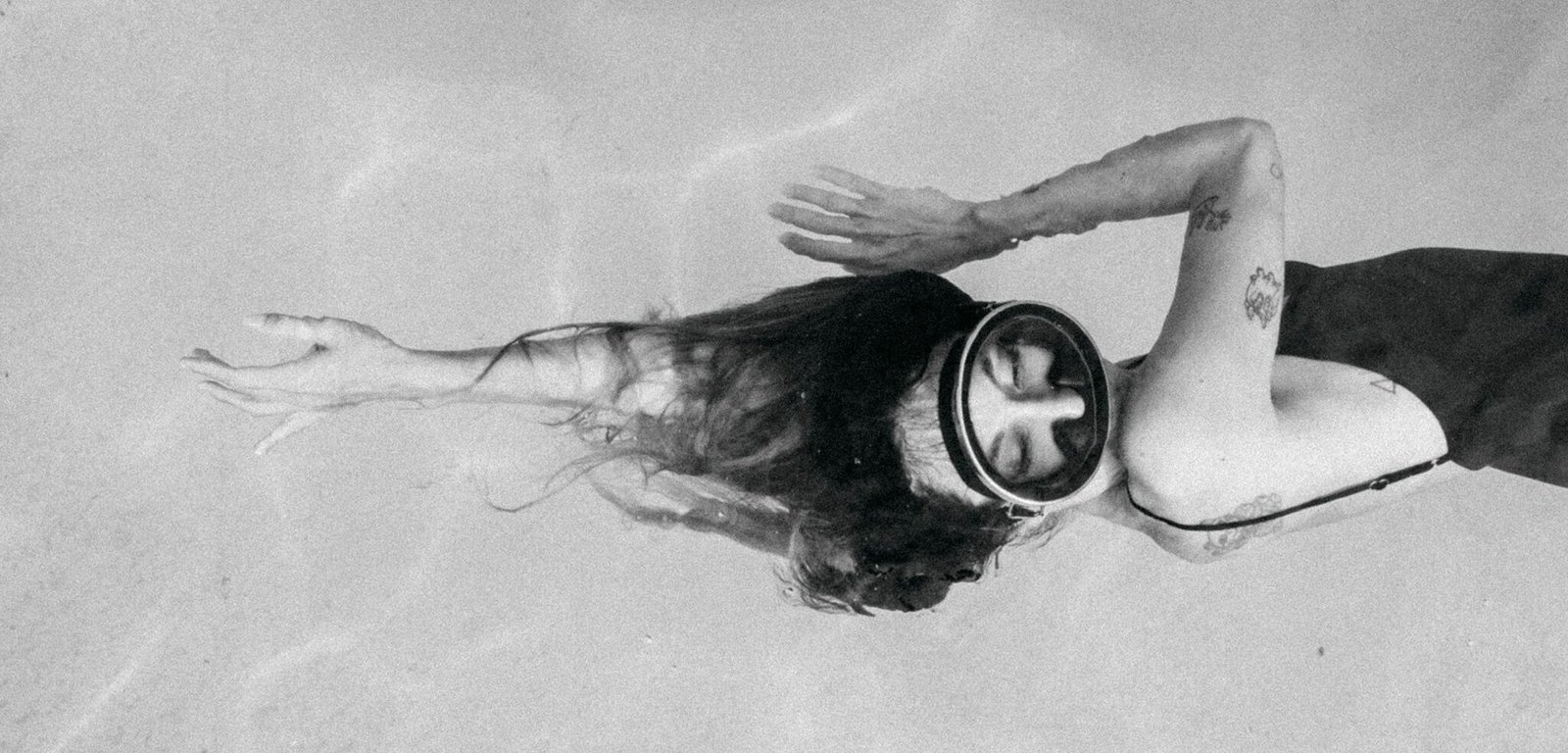
“Whenever I felt it coming on, I’d try and get into the shower or a bath, and then I started saying, ‘throw me in the pool’,” she says, laughing at the obscurity of the request. “I think there’s something about the zero-gravity feeling of being in water, every nerve in your body is in contact with the water, and there’s this contrast where the water is heavy, but your body is light.”

We often mistake healing for an additive process – more treatment, more medicine, more work. But for Deena, it was through subtraction that she began to heal. 

“You need to learn to do a lot less, but by doing less you can then do more…if that makes sense,” she says. “As in, the same thing takes less effort, less energy when you’ve rested.”

When Deena discovered freediving, the ocean became her sanctuary. It proved to be transformative. 

Immersion

On land, gravity is Deena’s enemy, pointing out her body’s miscommunicating circuitry with unforgiving certainty. But, in the water, gravity is replaced by buoyancy, and her limbs are suspended.

There is a biological process known as the mammalian dive reflex. The moment water touches your face, your heart rate drops. Peripheral blood vessels constrict, shunting oxygen away from the limbs to support the heart and brain. It is an ancient, dormant code written into our DNA, a reminder that we were once creatures of the sea.

This process slows your body and quiets your mind, and for Deena it also offered a sense of equilibrium. The more she dived, the more she explored the ocean, the more the experience intensified.

The descent into the deep requires her mind and body to dance rather than talk. Deena’s mind and body may not be capable of communicating with clarity, but they can still dance. 

“It’s like as soon as I come into contact with water, my neural pathways open up and my brain remembers there’s a pathway all the way to the end,” she says, the awe evident in her voice. “Doctors told me it was only going to get worse, but diving has given me hope through the moments where my body does work.”

In the deep, there is no Jaguar Jonze. There’s no advocacy. There’s no media (sorry, Deena). There’s no expectations. 

Deeper

The body does incredible things during a dive. Things many of us have no idea we’re capable of. Things written into our cells but long forgotten by our collective experience. 

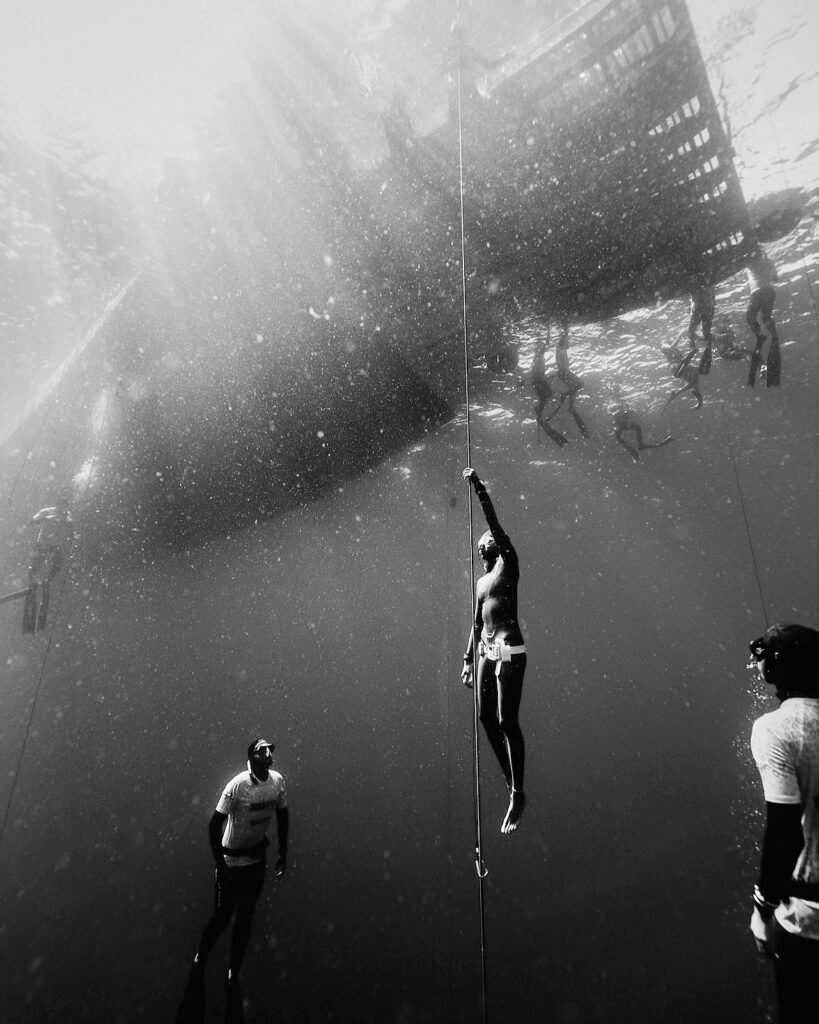
At twenty meters below the surface, the lungs are compressed to half their size. The pressure, though, is described as either a physical embrace, or a torturous squeeze (depending on who you ask). 

For many, this is where panic sets in. For Deena, it’s where she finds her strength. 

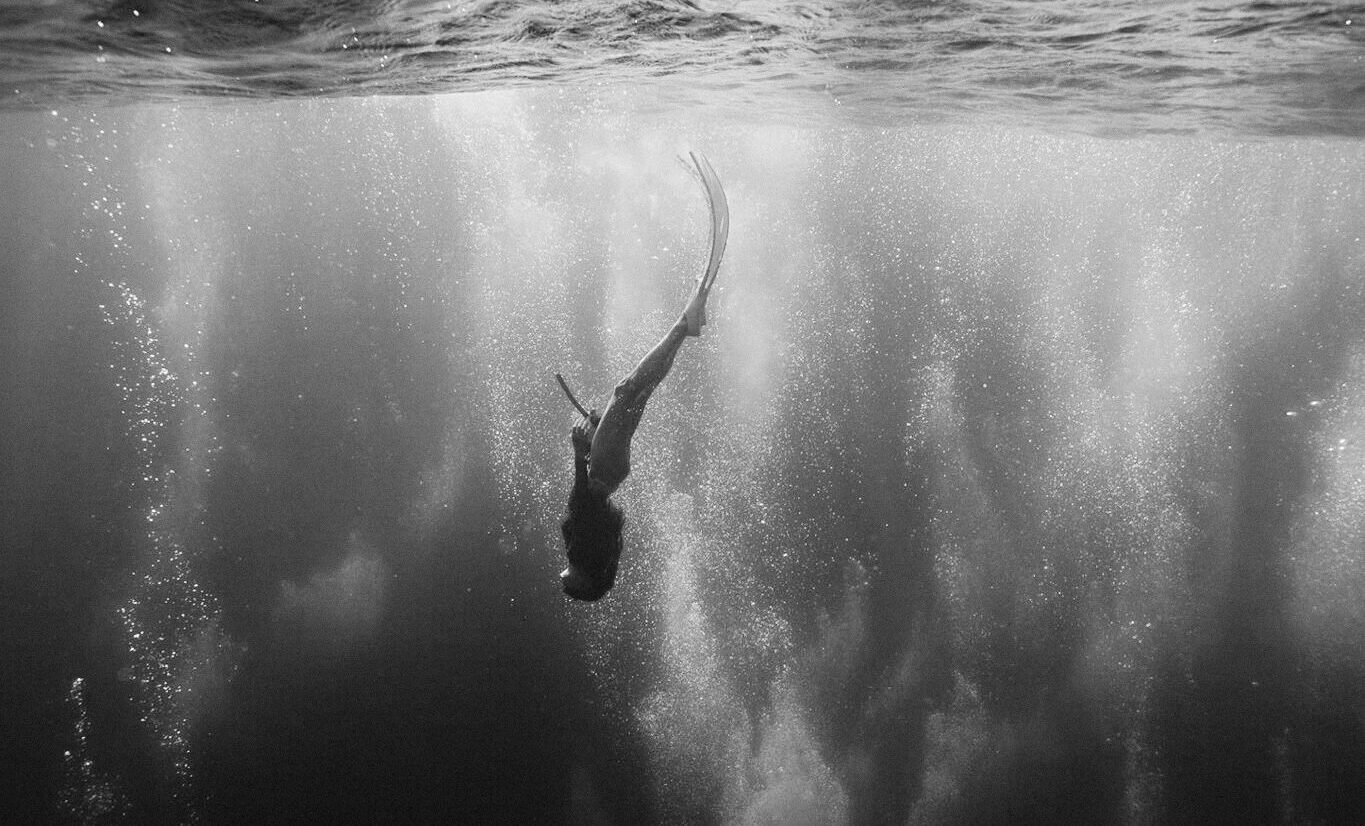
The air left inside the lungs no longer provides lift; instead, the body becomes negatively buoyant. This is the point where the ocean stops pushing you back to the surface and begins to claim you. It’s a moment of total surrender, a silent glide into the darkness of the deep. 

In this space, the urge to breathe is a liar – a biological alarm triggered by rising carbon dioxide, not a lack of oxygen. To freedive is to negotiate with this liar, who is often screaming and pleading, and to meet the fear of suffocation and find, within that defiance, a profound sense of peace.

“Everyone will tell you that freediving is a mental sport,” she says. “But really, It’s this intersection of breathwork, yoga, meditation, relationship with self, and nature.”

Deena’s journey to 30-plus metres below the surface of the ocean requires her to listen to her body, even if it isn’t listening back. It requires a level of internal surveillance that borders on spiritual. 

“So many sports, and the music industry too, can be run off high activation and adrenaline. Freediving is about complete relaxation. You have to monitor your heart rate and breathing so closely.”

Here, beyond 30 metres, the body’s inflammatory response is sent into a spiral. For Deena, her Lupus works against her, proliferating inflammatory markers. 

“I have to be extremely careful, because my body already has a lot of inflammation,” she says. “I’m on immune suppressants, but diving still hurts me.”

The dichotomy of the dive, for Deena, is that it is both giving and taking, healing and hurting. She isn’t going to stop, though, likening the inflammation to that which is caused by the stress of city life. 

“I had high inflammation markers in Brisbane too,” she laughs. “It’s all about how I monitor it, so I just have to really listen to my body and manage it.”

Deena’s relocation to Bali, where she now lives in a small fishing village, was a decision largely centred around reducing stress and embracing a simpler existence. She eats locally grown produce, freshly caught fish, and the pace is more natural.

Of course, it’s also an idyllic backdrop for her freediving journey. She dives weekly, sometimes more, and now instructs, too. 
Resurface

Deena’s free diving journey is about healing, discovery, perhaps even escape. It was never meant to be competitive. 

Mid-last year she qualified, somewhat by accident, to compete at the AIDA Freediving World Championship in Cyprus. 

Not one to retreat from challenge – quick to point out she’s usually challenging herself, rather than competing with others – she embraced the opportunity. 

Just weeks before the competition, Deena was advised by her medical team that it was too dangerous. They wouldn’t clear her to dive.

“That was just devastating,” she says. “I had no choice but to believe. I believed my body would do this for me. I know that sounds ‘woo-woo’, but I had no other choice. I was already in Cyprus, so I just assumed I’d be competing.”

The night before the competition, around 8pm, her doctor cleared her to dive.

“They told me I could dive, but it would be at my own risk.”

Just a handful of hours later, Deena was sitting aboard a small boat on the edge of a dive line in Limassol, Cyprus, set to represent Australia on the world stage. 

A person who just a few months ago struggled with the basic mechanics of a day’s movement, was descending 30, 40, 50 metres. Now just a solitary figure in a vast, indigo cathedral, captured in her essence as she was drawn deeper into the endless shades of blue. 

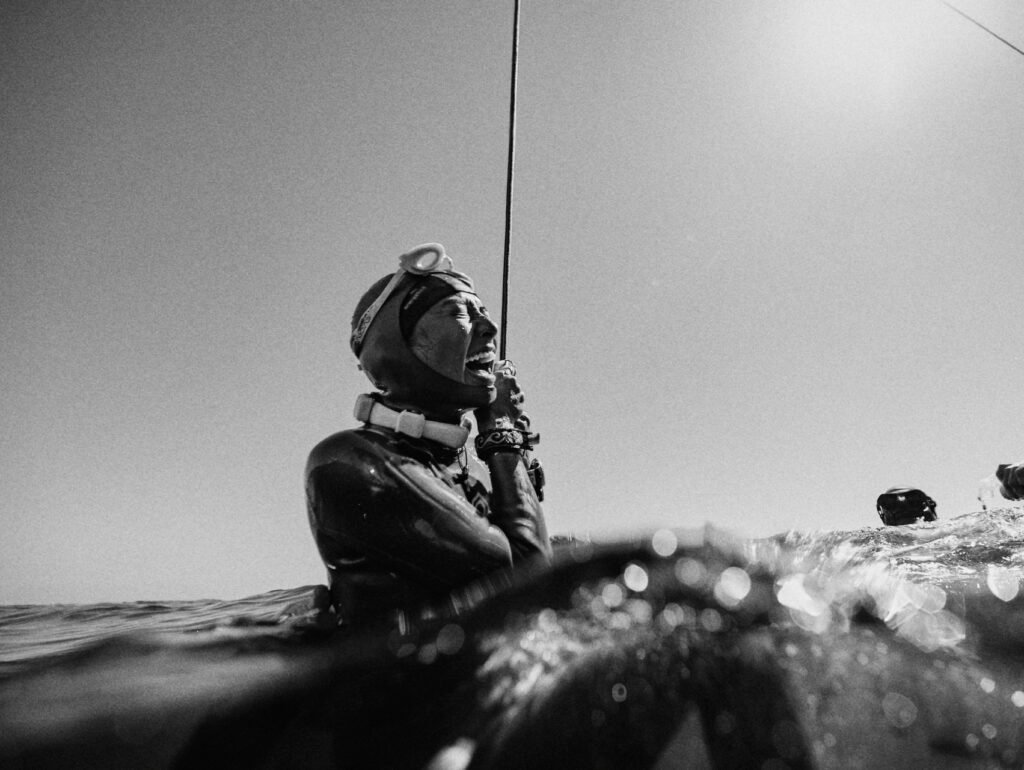
There, at the turnaround, an astonishing 55 metres below the surface, she found what she had been looking for. She wasn’t just diving for a number; she was proving that the recreation of the self is possible. It was in her eyes as she resurfaced – a scene that captured jubilation, determination, overwhelm, surrender, reclamation. 

“I don’t think I saw the cameras or the people,” she says, reliving the moment. “I just saw the white card. I’ve felt that on stage, it’s the exact same feeling where I’m completely connected with my body. That’s why performing is my favourite thing to do, so being able to have a moment like that again was so special, but in a completely different setting.”
As she moves forward, as a world-class diver, a musician, and an activist, Deena carries a newfound stillness. 

“Everything feels different now,” she says. “All of it has changed me, but freediving has definitely been central. When you achieve those moments of silence during a dive, it’s the best feeling in the world.”

She’s currently gearing up to release new music this year, too, as Jaguar Jonze returns after a two-year hiatus. Her first single, Naked, will land mid-May.

This time, though, she intends to integrate music into her life more sustainably, rather than playing into the industry’s chaos machine. 

“It’s very new to me, but I’ve realised music is my passion and my baby and it isn’t realistic to expect it to put a roof over my head. So it has to become art again, really.”

Deena Lynch has resurfaced, and she’s here to stay. 

Watch RESURFACING below, produced by Deena Lynch, directed and filmed by Callum Chaplin, with music by Motz Workman.

Your next Read

The most important thing about luxury, I’ve come to think, is in the detail. The …

A Design in Harmony with Nature Mira Earth Studios is a testament to thoughtful, nature-focused …

Last weekend, I ended up at Golden Plains, a big shroomy music festival in Meredith. …

The Genesis of a Design Visionary Reflecting on his roots, Dale Hardiman shares, “Adam and …