ROBE Haircare

Black

ROBE Masters Thinning Hair

31 March, 2026

Words by:

Sarah Palmieri

The Australian haircare brand blending tradition and modernity. We speak with ROBE founder Lauren Mackellar about everything from treating the hair and scalp holistically to slowing down and allowing a business to grow with meaning.

Last weekend, I ended up at Golden Plains, a big shroomy music festival in Meredith. Dirt, mud and rain had worked their way into my frizz-prone hair, and yet, by the end of day one, I’d received about five compliments on it. Winning.

The first came in the mosh. “Your hair looks like Yasmin from Industry,” someone shouted over Public Figures’ set. At the time, I didn’t know who Yasmin was, but I’ve since learned that this thin-haired girlie was receiving a very good compliment.

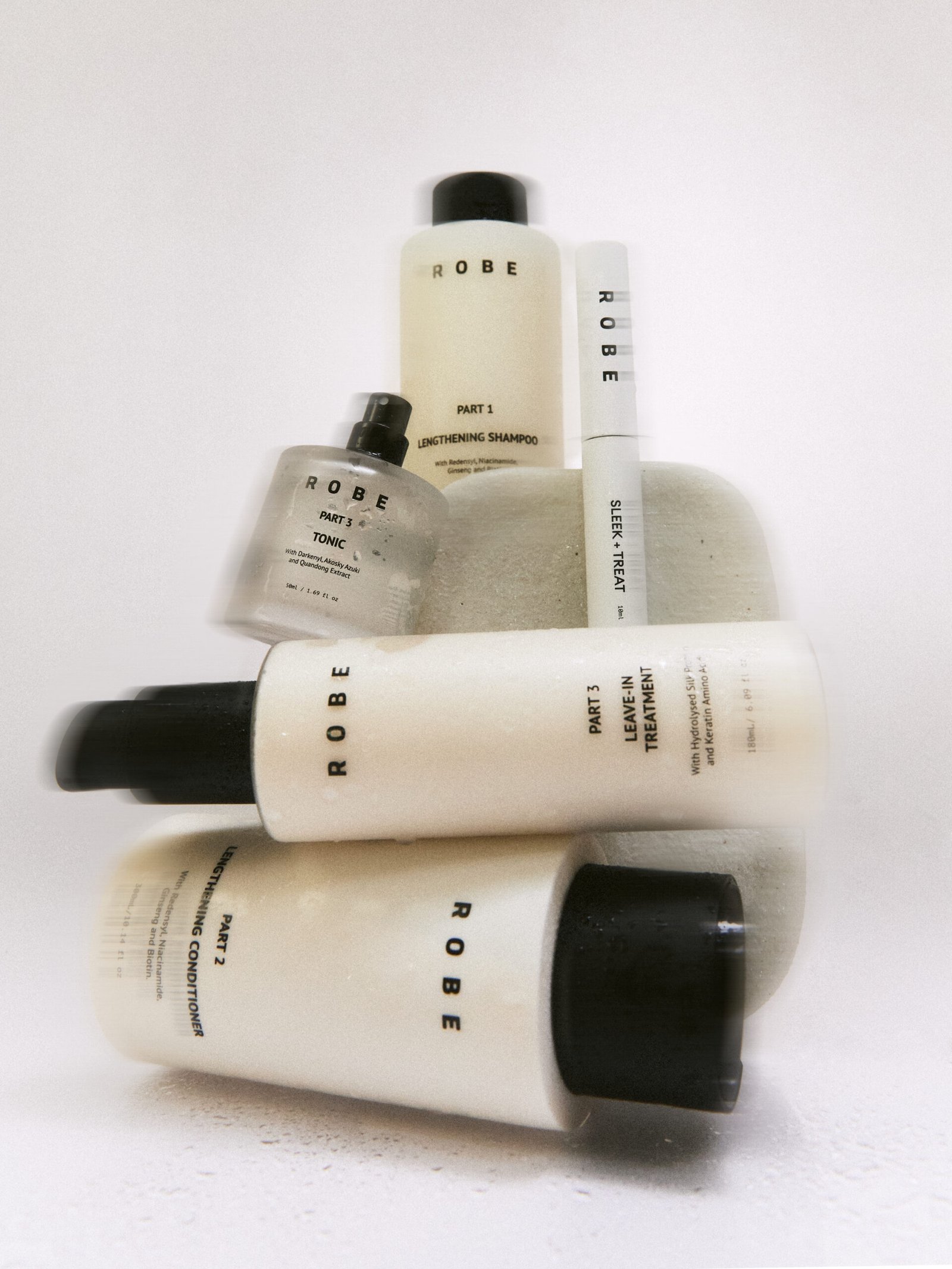
My locks had somehow kept their form, glossy and voluminous, and it was all thanks to ROBE. After years of trying different masks and supplements, and more than a few doctors’ appointments that yielded very little, I can say I’m all in on this Aussie haircare brand.

Hair, when it begins to change, has a way of making things feel overwhelming. At least for me it does. The search for the right product or fix for what is often framed as a problem quickly becomes the modern-day hunt… It sends me down a rabbit hole of “best of” lists and sponsored content that rarely delivers what I’m hoping for.

For ROBE founder Lauren Mackellar, haircare and hair thinning are both more complex and far simpler than we often make them. Drawing on Chinese and Ayurvedic medicine, alongside her experience as a hairdresser and entrepreneur, Mackellar takes on hair holistically.

I spoke with Lauren about why she started ROBE, how traditional medicine informs her approach to formulation, and how learning to embrace our hair wherever it is can become a form of self-care.


What led you to create ROBE?

During my career as a hairdresser, and through my own personal experience with hair loss, I realised that although many women were navigating significant changes with their hair, very few people were speaking about it openly.

Hair loss and hair thinning are incredibly common — whether it’s postpartum, stress-related, hormonal shifts, or the changes that come with perimenopause. Yet at the time, there were very few products designed to support women through those transitions. The few options that existed were largely targeted toward men, and they often felt clinical or medicinal in their approach.

At the same time, I had been exploring herbs and plant-based ingredients that had long histories of use in traditional medicine. I was seeing beautiful results from them, but there was very little available in modern haircare that translated those ingredients into something both effective and enjoyable to use.

Creating ROBE was my way of bridging those worlds — bringing together traditional botanical wisdom with modern formulation, and presenting it through a lens that felt luxurious, thoughtful and empowering. I wanted haircare to feel less like a problem to fix, and more like a ritual that reconnects you with your hair in a positive way.


How has your experience as an entrepreneur evolved since launching ROBE?

When I first began, I was a hairdresser with a lot of passion but very little formal business experience. I had spent my career working freelance in the fashion and editorial world, so launching a product brand meant learning an entirely new set of skills.

During the development phase of ROBE, my life changed quite dramatically when I was diagnosed with a brain tumour that required immediate surgery, followed by around eighteen months of treatment. That experience reshaped the way I approach both work and life.

Since then, I’ve had to learn to manage my energy very differently — balancing the realities of reduced cognitive stamina while still making thoughtful, long-term decisions for the business.

One of the biggest lessons has been accepting a new pace of growth. Early on, I felt a strong urgency to build the brand quickly and reach as many people as possible. Now, I’ve learnt that growth can be slower and still be meaningful. Being gentle with myself, allowing room for mistakes, and recognising that the business can evolve in a more sustainable rhythm has been an important shift.

In many ways, ROBE has grown alongside me.


ROBE draws on both Ayurvedic philosophy and Chinese medicine. How do these traditions influence the way you approach haircare?

ROBE draws inspiration from both Ayurvedic and Traditional Chinese Medicine philosophies, particularly the idea that balance within the body is reflected externally — including through the health of the hair and scalp.

In both systems, the scalp is seen as a living environment that needs nourishment, circulation and balance in order for hair to grow well. Rather than focusing on a single “miracle” ingredient, these traditions often combine multiple herbs and botanicals that each support the system in different ways.

That philosophy influences how I formulate the range. Some ingredients are chosen to stimulate circulation and encourage growth, others to calm inflammation or soothe the scalp, and others to strengthen the hair fibre itself.

The goal is to support the scalp holistically so it can return to a state of balance. From there, healthy hair can grow — regardless of your hair type, age, or starting point.

The beauty industry is shifting in many ways right now. How do you see it at the moment, and what role do you hope ROBE plays within it?

One of the shifts I’m happiest to see within the beauty industry is the growing celebration of individuality and natural beauty.

When I first started my career as a young hairdresser, the visual standards within beauty were extremely narrow. In hair advertising especially, the imagery often centred around long, thick, almost supermodel-style hair that most people simply don’t have.

There wasn’t much representation for fine hair, thinning hair, or hair that was evolving with different stages of life.

When I launched ROBE, I wanted to challenge that a little. Our launch campaign featured a model with naturally fine hair — no extensions, minimal makeup — because I wanted people to see that fine hair can be beautiful in its own right.

It’s been incredibly encouraging to see that some of the hero products in the range are the ones designed specifically for finer hair types, which historically have often felt like an afterthought in larger product ranges.

Personally, my approach to hair has also evolved. For many years I relied on extensions to feel more confident about my own hair, particularly during periods where stress caused visible thinning. Learning to embrace my natural texture and work with my hair rather than against it has been an important personal shift.

Through ROBE, my hope is to encourage people to lean into what makes their hair uniquely beautiful — and to show that caring for your hair doesn’t need to involve twenty products or a forty-five minute styling routine.

I’m also proud that Australian beauty culture tends to lean toward a more effortless aesthetic. There’s a real appreciation here for simplicity, multifunctional products, and a “less is more” approach. I love seeing other Australian founders embracing that same philosophy.


Have there been any people or founders who have particularly inspired you along the way?

Zoe Foster Blake has definitely been someone whose journey I’ve admired. She was actually a client of mine many years ago, long before Go-To Skincare existed, so watching her build such a successful and recognisable brand has been incredibly inspiring.

Closer to home, I’m also really inspired by fellow Australian founders like Ava Matthews from Ultra Violette and Hilary Holmes from Holme Beauty. There’s something really special about the way many Australian beauty founders support each other and build thoughtful brands.

Internationally, I’ve also been very inspired by Vicky Tsai from Tatcha. I recently learnt more about her story, and I loved the honesty she shared about the ups and downs of building the brand, and her determination to create products that came directly from her own personal experience.

Those kinds of founder stories — where a product begins with something deeply personal — are always the ones that resonate most with me.

Hair is deeply personal. It reflects our health, our stress, our hormones, our life stages. My hope is that ROBE can help people move away from the pressure of perfect hair and instead feel more connected to the hair they actually have.


What’s next for Robe?

There are a few exciting things coming this year.

One is a silicone-free serum that focuses on shine, smoothness and long-term hair health without relying on heavy synthetic coatings. The other is a growth-supporting styling product that sits somewhere between treatment and styling — which I’m particularly excited about.

In the background, I’m also developing formulas that connect more deeply to the idea of haircare as ritual. That direction has become even more meaningful to me after losing my hair during cancer treatment. During that time, small daily practices — caring for my scalp, gentle massage, herbal treatments — became incredibly grounding.

I’d love for ROBE to continue evolving toward that intersection of hair health and self-care.

Long term, I also have a concept for a digital platform for the ROBE community — something like a “hairdresser on call,” where people could access personalised advice, styling education, and hair health support. It’s still very much a thought bubble, but it’s a fun idea to imagine for the future.

 

Your next Read

You’d be forgiven for experiencing a kind of EV whiplash lately. New models arrive by …

The brand did not emerge from a desire to disrupt skincare so much as a …

If you’ve ever spotted a faceless surfer god riding a cosmic wave on a t-shirt, …

The beauty industry can be loud. New launches every week. Promises of instant glow. Before …