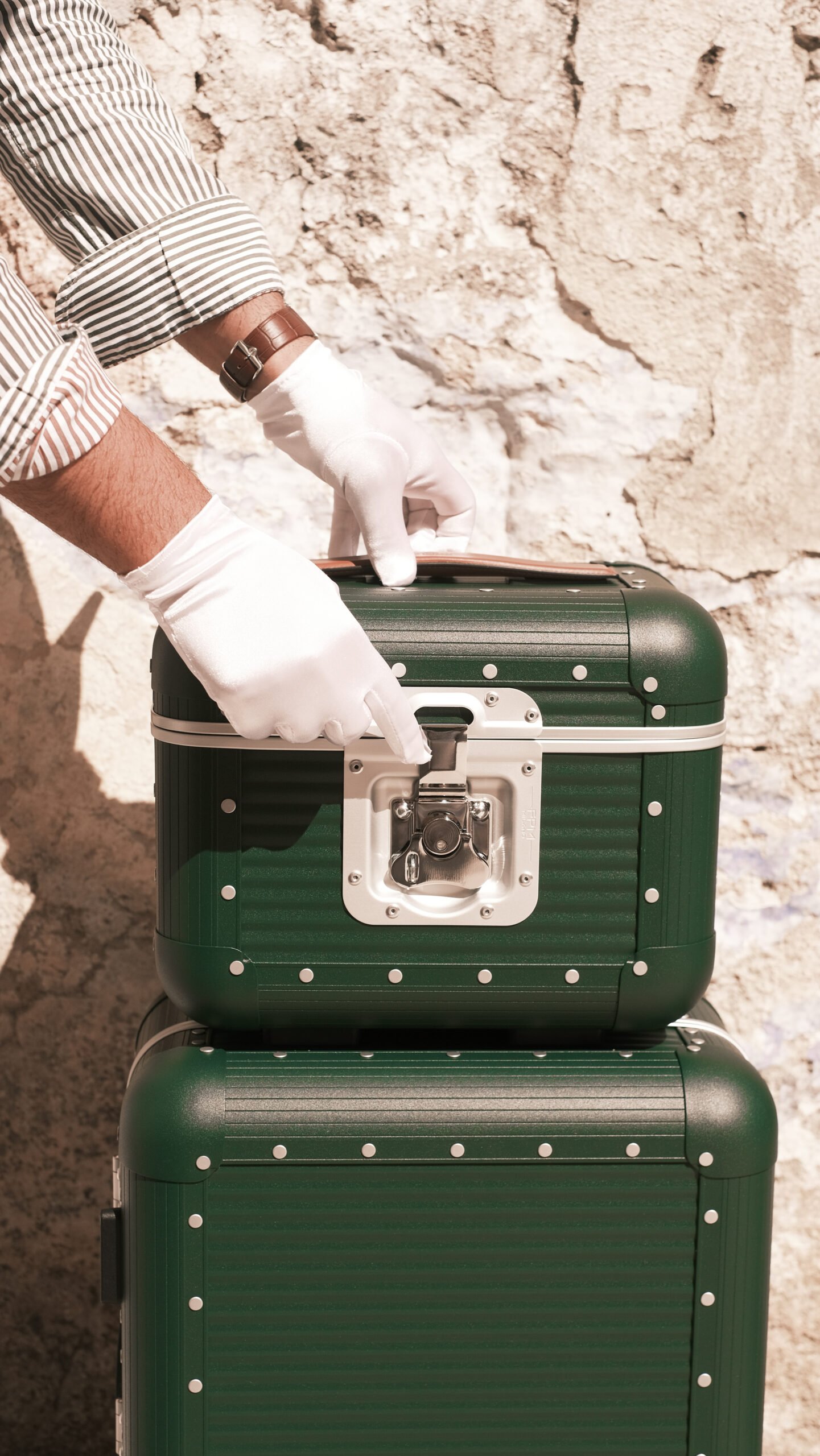
An aluminium suitcase must be the chicest possible travel accessory. A companion that belongs in the same conversation as great craftsmanship, serious durability, and an aesthetic that doesn’t date. You see it resurface every time Jacob Elordi steps off an international flight in head-to-toe Bottega Veneta, or Margot Robbie moves through an airport in something pulled from our beloved Beare Park. The aluminium case is always in frame. Always right.
But spotting a trend and following it is easy. Our consumerism is flooded by exactly that. So when it comes to buying something intended to last, to actually earn a permanent place in your life, the question of craftsmanship and legacy becomes integral. That’s how I came across FPM Milano.
The full name is Fabbrica Pelletterie Milano, the Leather Goods Factory of Milan. It was founded in 1946 by Enrico Fremder, who set up a small workshop on Via Tito Vignoli with an ambitious goal: to show the world the beauty of Italian craft. Fremder wasn’t a man who thought small. In that same founding year he co-established ANIMPEC, the first trade association for Italian leather goods manufacturers, pulling together ten other firms to collectively advocate for and elevate the industry. That organisation eventually became Assopellettieri, and remains the most significant body representing Italian leather goods producers today. In 1962, Fremder went further, co-founding MIPEL, which grew into the most important international trade fair for leather goods and accessories. He was, in other words, not just building a brand but building an entire infrastructure around it.
Shortly after founding the factory, FPM opened a branch on Fifth Avenue in New York, a significant and early statement of international intent, maintained from 1956 to 1964. There is something quietly telling about that. A small Milanese workshop, barely a decade old, already positioned on one of the world’s most visible commercial streets. The ambition was never modest.
Enrico’s son Beppi eventually joined the business in 1975, but his path would take him elsewhere first. He spent years at Samsonite, rising to chief commercial officer for Europe before moving into private equity. When he eventually looked at what the family had built, the thinking was direct: there is a great company here, why not build it properly? The dormant FPM reawakened. It was a revival that understood something most heritage revivals don’t: that the original soul of a thing is worth recovering, not reimagining beyond recognition.