Heating People, Not Rooms

Black

Heating People, Not Rooms: The Stoov Story

29 July, 2026

Words by:

Justin Jackie

How Stoov founder Teun van Leijsen turned a broken heated car seat into a smarter way to stay warm.

Australians like to insist that we don’t really have winter. This is usually said by someone standing outside in a T-shirt, or by a European who has never spent July inside a Sydney rental built in the 1940s.

My apartment has many of the period details people tend to admire in real estate listings. Less is said about the gaps around every window, the uninsulated floorboards and the apparent absence of anything useful between the ceiling and the roof. During a cold snap, the thermometer inside often reads little differently to the overnight minimum outside, and it can stay that way well into the afternoon.

Like plenty of people living in older Australian homes, I have developed an improvised winter strategy involving socks, jumpers, blankets and an unreasonable amount of time spent deciding whether turning on the heater is really worth it. The heater itself works perfectly well. The issue is that much of the warmth immediately disappears through the windows, floorboards and every other escape route the building has kindly provided.

Which raises a fairly obvious question. Why am I paying to heat an entire apartment when, most of the time, only one person is sitting on the couch?

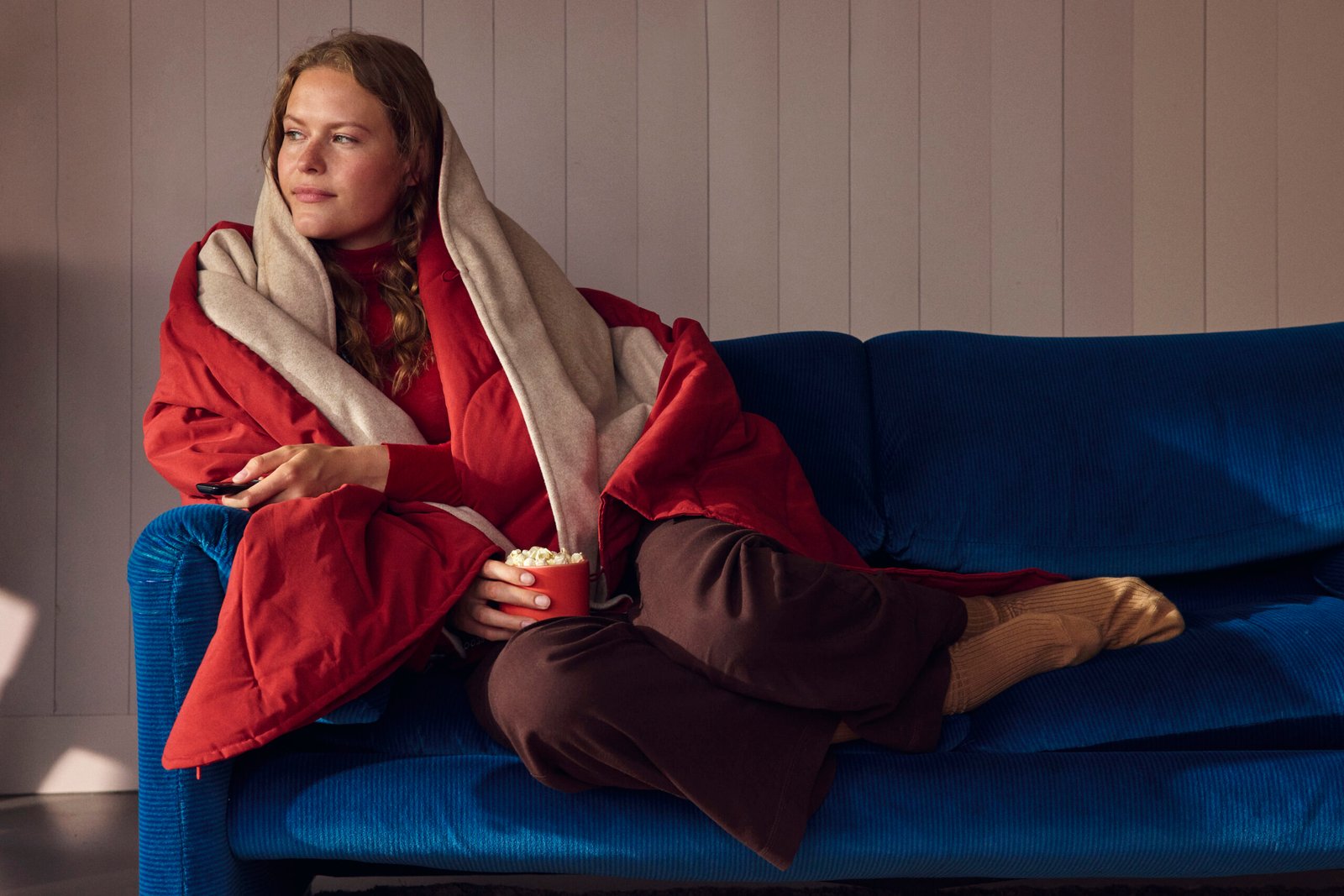
It is a question Dutch company Stoov has been answering for more than a decade with a range of cordless heated cushions, blankets and seat pads designed to warm the person using them, rather than all the air surrounding them. The principle is familiar to anyone who has used a heated car seat. The cabin can still be freezing, but once your back and legs are warm, the urgency to crank the climate control quickly disappears.

Curious about the thinking behind the idea, I recently sat down with Stoov founder Teun van Leijsen and Head of Product Development Lisa van Steenbergen to learn how a broken heated car seat evolved into a company reconsidering the way we keep ourselves warm.

For Teun, the idea first appeared more than 20 years ago after he bought a second-hand car with heated seats that no longer worked.

“I’m not a technical guy, but I’m a curious guy,” he tells me.

He opened the seat, examined the technology hidden inside it and was surprised by how straightforward the basic principle appeared.

“Why is this only in car seats?” he remembers thinking.

Then life continued. Teun concentrated on his job and the question receded into the background, occasionally returning without becoming anything more concrete. Almost a decade later, he was married, expecting his first child and living in a home with a small garden.

His wife loved sitting outside, but once the evening became cold, she would inevitably head indoors. Teun wanted her to be able to enjoy the garden they had waited for, so he bought the necessary components and began assembling a heated cushion in his shed.

She loved it, although he concedes that she may not have been the most impartial product tester. More importantly, the prototype showed him that the technology worked perfectly well outside a car.
Even then, Stoov did not materialise overnight. It took another three years for Teun to find the courage to leave his job at a bank and see whether anyone else might want one.

He returned to the shed, gathered batteries, heating elements and whatever else he needed, then took his prototype into Utrecht by bicycle. His first customers were not furniture stores or design-conscious homeowners. They were restaurants with outdoor terraces and a very obvious problem.

Patio heaters sent warmth upwards and out into the open air, while the people sitting beneath them remained cold. A heated cushion placed the warmth exactly where it was needed.

Teun began knocking on doors and eventually sold around 20 of his early cushions. Selling them turned out to be the easy part. Keeping those handmade prototypes working through an entire Dutch winter meant spending countless hours with a soldering iron, repairing and refining them as he went.

It was a modest and slightly chaotic beginning, but it established the essentials of the Stoov product that followed: cordless operation, battery power and washable covers. After a year spent developing the electronics, construction and fabrics in-house, Stoov formally began taking shape around 2014.

Its name, fittingly, reaches much further back.

Teun explains that a stoof was a small wooden foot warmer once used in Dutch homes and churches. Hot coals were placed inside a box with holes in its top, allowing someone to rest their feet above it and hold onto a little warmth. Examples can still be spotted in old Dutch paintings.

It was a simple form of personal heating created long before radiators and reverse-cycle air conditioning encouraged us to think in terms of warming entire spaces. Stoov may use batteries rather than hot coals, but the underlying instinct is much the same.

There is also, Teun jokes, a particularly Dutch appreciation for finding the least expensive way to stay comfortable.

“We like to spend money, but in the cheapest way possible.”

That focus on efficiency has helped Stoov find an audience across Europe, although the reasons people buy its products differ from one country to another. In the Netherlands, saving energy has been a particularly persuasive argument. German customers were already familiar with personal heating products, but Stoov found more interest there in wellness and in creating something attractive enough to live with openly.

Australia presented a different challenge.

Teun pointed out that I had chosen to take our video call outside, despite it being the middle of winter. For someone in the Netherlands, where the colder months are associated with retreating indoors, that was evidence of a very different relationship with the seasons.

“The moment you get the opportunity to go outside, you take the call outside,” he says. “That’s a completely different way of thinking.”

Australia may be full of poorly insulated homes, but we also spend much of the year attempting to stay outdoors for as long as possible. That makes a portable source of warmth useful on both sides of the window. It might sit on the sofa while someone works from home, then move outside for dinner, a morning coffee or an evening spent refusing to admit it has become too cold.

The technology may do the warming, but Lisa’s job is to make sure the finished product does not feel like technology.

Before joining Stoov four years ago, Lisa studied fashion design and worked for a number of fashion companies. Over time, she became increasingly interested in where products came from, how they were made and the materials behind them. A later role with a knitwear producer took her to factories in China and India, where she learned more about fibres, textiles and dyeing.

It also sharpened her frustration with the speed of the fashion industry.

“I was fed up with reproducing every year the same T-shirt in a different colour,” she says. “I looked for something more sustainable, and textiles with a purpose.”

For Lisa, a Stoov product is defined by the balance between that purpose and its appearance. It has to keep someone warm, but it should also fit naturally into the way they already live.

“You don’t have to hide it,” she says. “You can enjoy it, you can cuddle it, still look pretty and be warm.”

Teun describes a similar ambition. Older heating products were often brought out when needed, then hidden in the bedroom or cupboard when visitors arrived. Stoov’s cushions and blankets are intended to remain in view, looking more like home furnishings than appliances.

The distinction matters. A heating product can be efficient, safe and technically accomplished, but none of that means much if it spends most of its life packed away.

As Head of Product Development, Lisa sits at the intersection of textiles, engineering and design. She develops new products alongside an engineer and product designer, with many of the early prototypes made inside Stoov’s own workspace. There is a sewing machine and, in her description, enough hands-on work to keep the process from becoming entirely screen-based.

“We can do some arts and crafts,” she says.

A new product can take around nine months to develop, or longer when the technology becomes more complicated. The team is already considering more ways to use Stoov outside, along with products that move closer to furniture, sleep and clothing.

Teun is interested in wearable pieces that are not tied to a single fashion season, while Lisa sees potential in smart textiles that could integrate warmth into the fabric itself.

“I think it’s very interesting to make the hybrid between technology and textiles,” she says.

Stoov has also explored that relationship through collaborations, including one with Dutch textile innovator BYBORRE. Lisa was drawn to the company’s knowledge of knitting and its efforts to return textile manufacturing to the Netherlands.

The fabrics are made to order rather than held as excess stock, use recycled fibres and bring an unusually tactile quality to what remains, underneath it all, a battery-powered product.

That collision between textile craft and heating technology is where Stoov is at its most convincing. The battery and heating element are essential, but they are not meant to dominate the experience. The product should first feel like something soft, familiar and worth keeping nearby.

The less charming reality is that any cordless product still relies on a battery, and Teun is open about the environmental compromise that introduces.

The fabrics use recycled materials, while the products are designed so their parts, including the battery, can be separated at the end of their life. Stoov continues to follow developments in alternatives such as lithium iron phosphate and semi-solid-state batteries, but Teun does not pretend his company controls the pace of battery innovation.

“We are a frontrunner, but we’re not the innovator there,” he says. “We follow what’s available on the market.”

Adopting new technology too early can make a product unaffordable or create problems with availability. It is not a completely satisfying answer, but it is a more believable one than claiming a battery-powered consumer product carries no environmental cost at all.

For now, Stoov’s strongest efficiency argument remains the simplest one. It directs energy towards an individual instead of trying to change the temperature of every cubic metre around them.

That does not mean abandoning conventional heating or accepting that the rest of the house should feel like a refrigerator. It means being more selective about when the entire room genuinely needs to be warm.

By the time my conversation with Teun and Lisa wrapped up, the thermometer in my apartment hadn’t moved.The floorboards were still cold. The gaps around the windows were still doing what they’ve always done. It was, in every measurable way, exactly the same apartment I’d been sitting in before the interview.

The only difference was that, instead of wondering whether I needed to heat the whole room, I found myself looking at the empty space around me and wondering why I ever thought I had to.

Your next Read

I’m in the Northern Territory with Hino Trucks, for the Darwin Supercars round, and with …

The market grew, and grew, reaching its zenith in late 2021, as Wall Street investors, …

TAG Heuer released its first-ever mechanical split-seconds watch last year, in what is arguably the …

It’s taken time for Melbourne to develop a winter culture, but RISING has been a …