Tasteful Evolution:

The Mazda 6e Captures Heritage

White

Mazda’s First EV Remains Recognisable

28 August, 2026

Words by:

Cobey Bartels

Mazda’s first electric sedan takes its heritage into the future, through thoughtful design that stands out from the crowd.

A sort of amnesia has taken hold across the automotive design world. In the feverish rush toward zero emissions, car design has succumbed to monotony, and brand identity has taken a backseat. You have almost certainly noticed it. On the road today, cars have, by and large, begun to look identical. Especially EVs. 

It raises the question: have designers forgotten how to be original?

The classic three-box sedan has suffered the most, increasingly resembling a smooth, featureless appliance. Sure, some interesting design themes have emerged, but at some point sweeping LED arrangements and giant touchscreens and ever-larger wheels stopped feeling original, or even particularly thoughtful, instead feeding into the monotony at play.

This is partly a symptom of industrial haste, the dizzying speed at which brands are expected to churn out new metal, but it also comes down to the limitations of electric architecture. Structurally, almost all EVs are built on shared platforms, which allow for greater speed to market but come with inherent design constraints. Then, within the platforms there are floor-mounted battery packs, which force rooflines skyward, and bring serious weight. This means a greater reliance on aerodynamics to claw back efficiency lost to height and heft, which in turn smooths and softens body lines.

Almost every brand seems to have arrived at the same compromise; form has dissolved into consensus. Sedans are bigger, softer, they all look too similar, and yet, according to Yoshito Iwauchi, Chief Designer for the Mazda 6e, that doesn’t have to be the case.

In 1999, as a rookie designer in Hiroshima, Iwauchi’s first assignment was sketching the wheels for the original Mazda 6. As the only designer to have now touched all four generations of the nameplate, Iwauchi faced an unusual paradox when he began designing the 6e: How would he take nearly three decades of heritage into the electric future, when the base vehicle wasn’t even a Mazda?
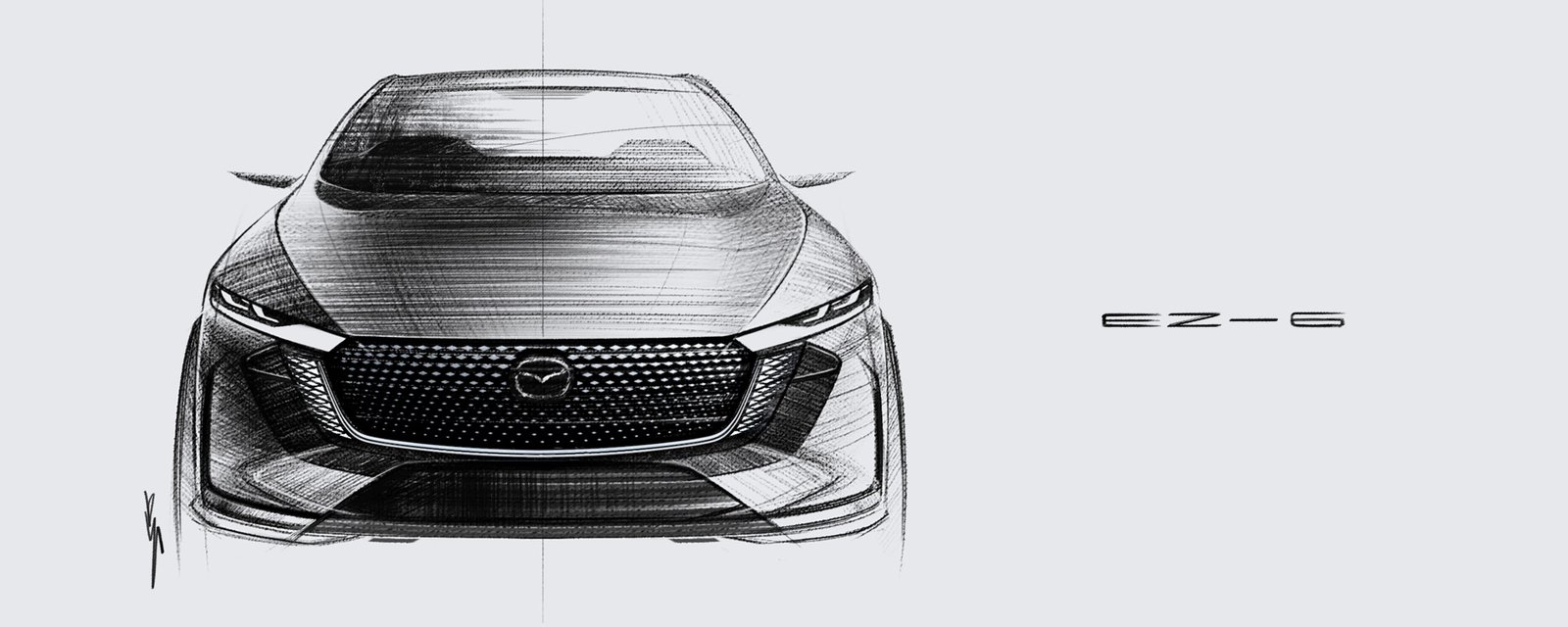
Beneath its Mazda skin, the 6e rides on Changan’s shared EPA1 electric architecture, the same platform used for the Deepal SL03 and L07. Iwauchi’s goal was to instil a distinctly Japanese form upon the donor car, working around the fixed wheelbase, roof height and other parameters he didn’t get a say in.

Had he been handed a completely blank sheet of paper, Iwauchi admits he’d have done things differently. He would have pushed the front axle forward and extended the bonnet, for starters. “I would have liked the wheelbase to be longer, and the front end with a longer bonnet, characteristic of Mazda design,” Iwauchi reflects.

Accepting the fixed hard points, Iwauchi drew upon his learnings from other models he’s designed, like the previous-generation Mazda 6, CX-3, CX-30 and MX-5, as well as revisiting design elements featured on heritage models. In the end, the only exterior body component the 6e shares with its donor is the side window glass, and even then, Mazda flattened the lower window line along the belt to eliminate the donor car’s upward kink.

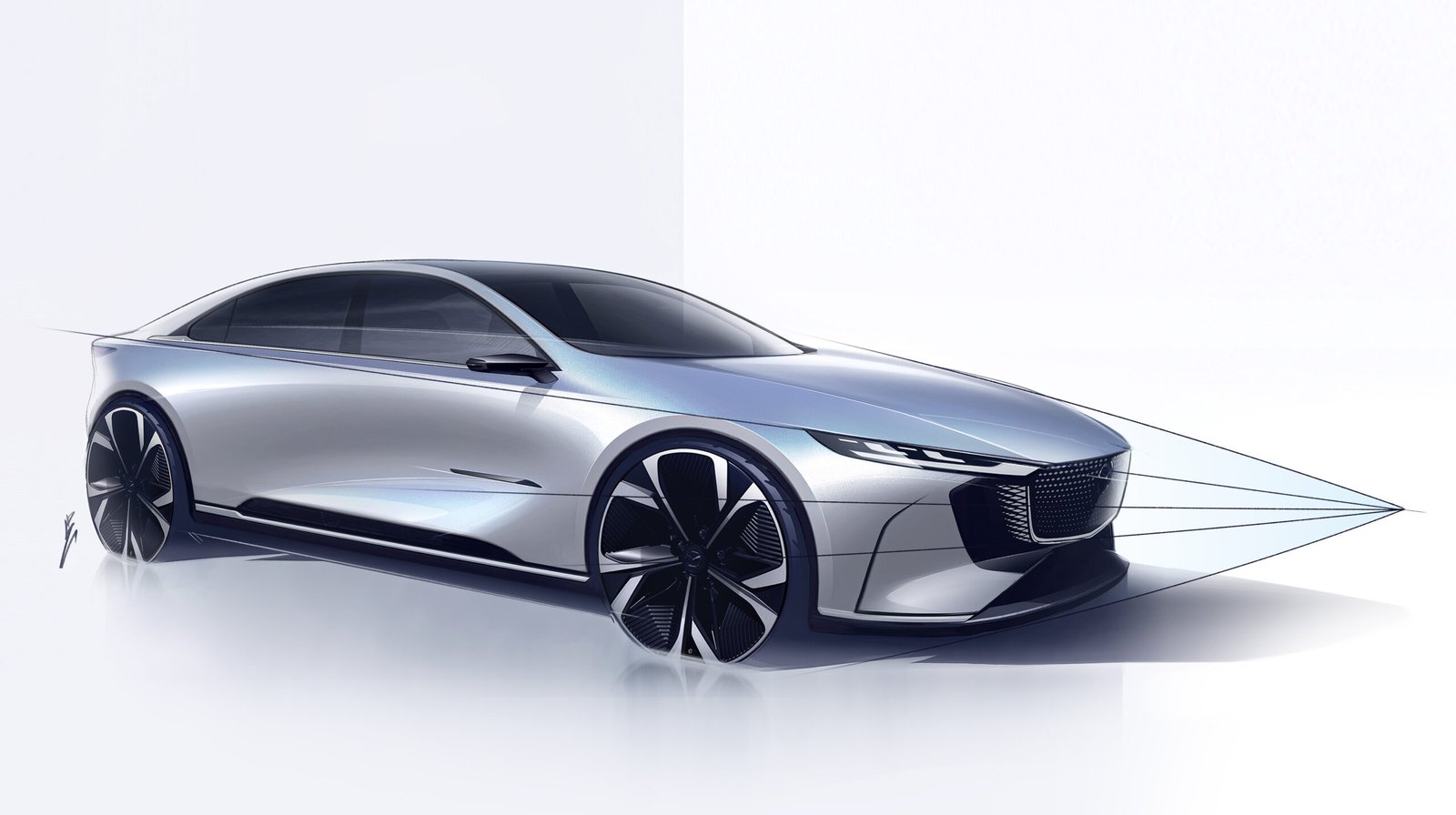
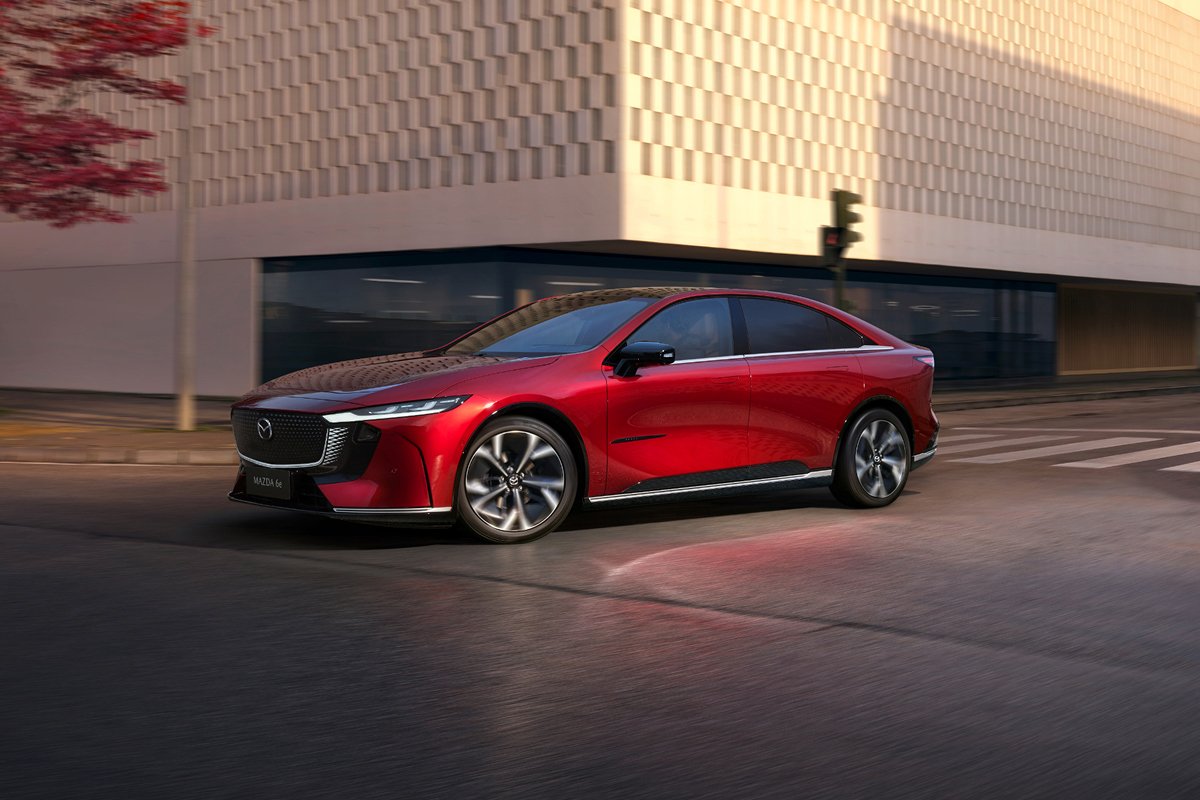
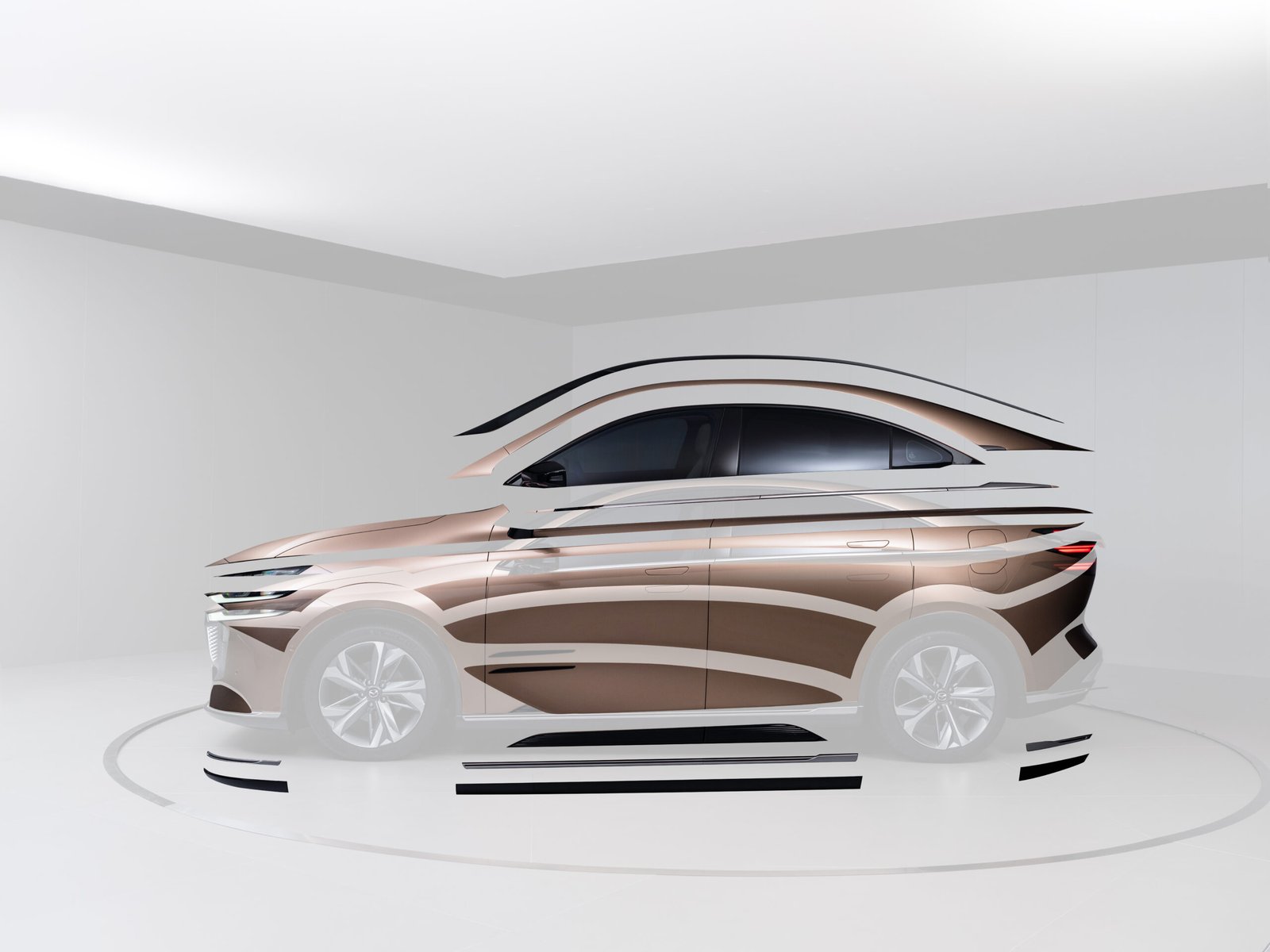
Iwauchi turned to optical tailoring to save the 6e from the thick, slab-sided proportions that plague so many electric sedans. His team sliced the bodywork horizontally, installing a dark, recessed sill along the bottom edge while etching a sharp, continuous shoulder line across the doors. “Much like using pinstripes to create a slimming effect for a suit, we used dark cladding at the base of the doors and sweeping horizontal body lines spanning the length of the vehicle to create the illusion of a low roofline,” he explains.

By layering these horizontal reflections, the eye registers a sleek, low silhouette despite the crossover dimensions. The delicate surfacing reflects Mazda’s insistence on tactile craft over digital computation. While the automotive industry now almost exclusively uses software to design cars, Iwauchi also relied on more traditional methods for the 6e.

“We worked with our usual clay modelers, and while we integrated digital development to speed up the process, we made sure it was done by human hands,” he says. 

That tactile discipline was maintained during production setup at the joint Changan-Mazda plant in Nanjing, China, where Mazda established a dedicated Dojo – a specialised training hall where local workers were trained by Japanese Takumi masters to run their bare hands across raw metal press dies, evaluating surfaces by touch rather than relying solely on laser scanners.

Mazda was careful not to blindly follow EV trends, balancing heritage with modern technology features when designing the 6e. Up front, the signature Kodo wing framing the fascia is illuminated around its lower perimeter, serving as a charging status indicator, while maintaining a profile that honours that of the previous 6.

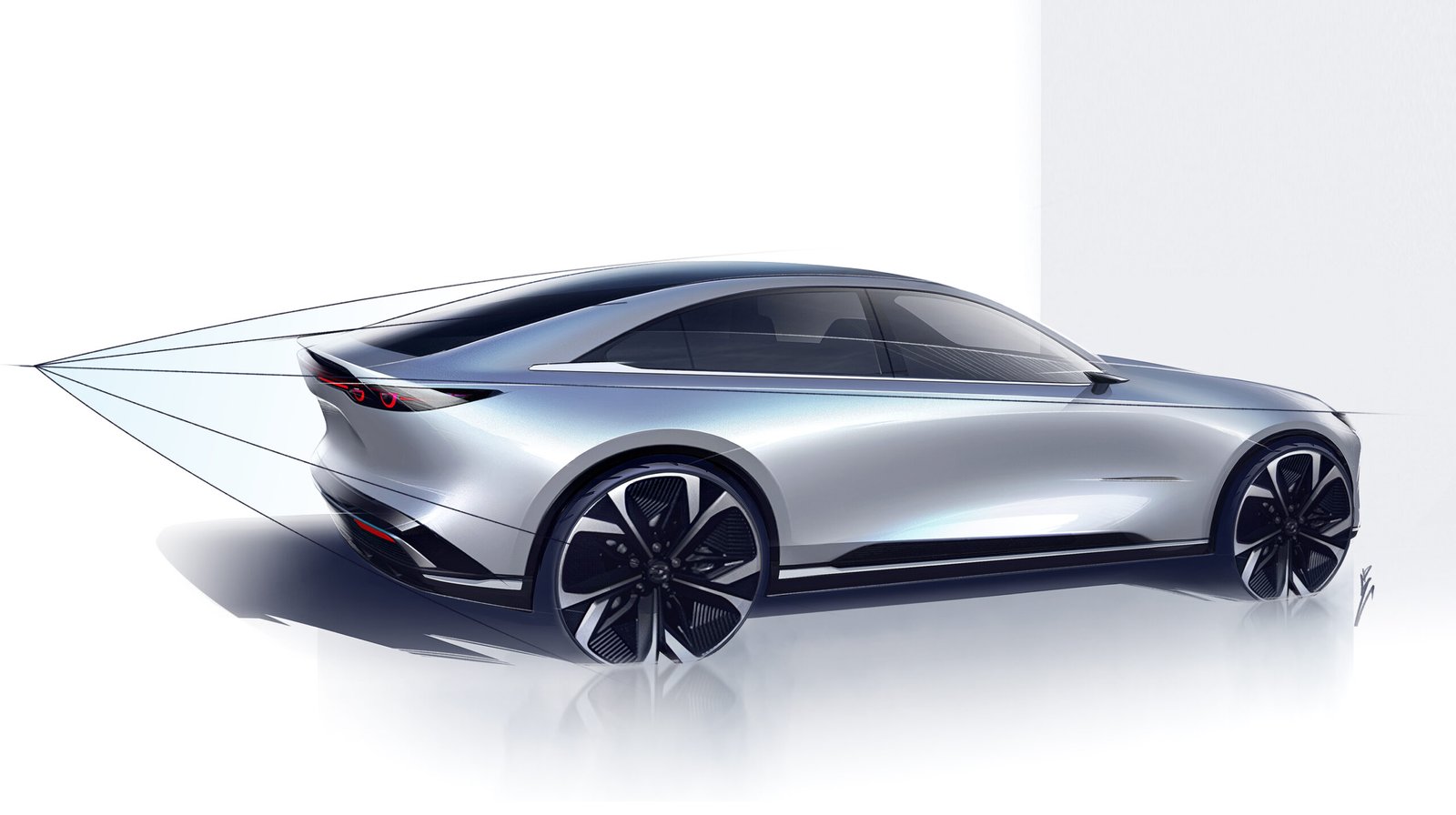
At the rear, four circular light elements pay homage to the FD RX-7 of the ‘90s, and current-generation Mazda 3 hatch. Above them, in a design nod to the earlier 626, an active rear spoiler deploys automatically at 90 km/h to maximize aerodynamic efficiency; when stowed at rest, it sits completely flush against a pronounced ducktail lip.

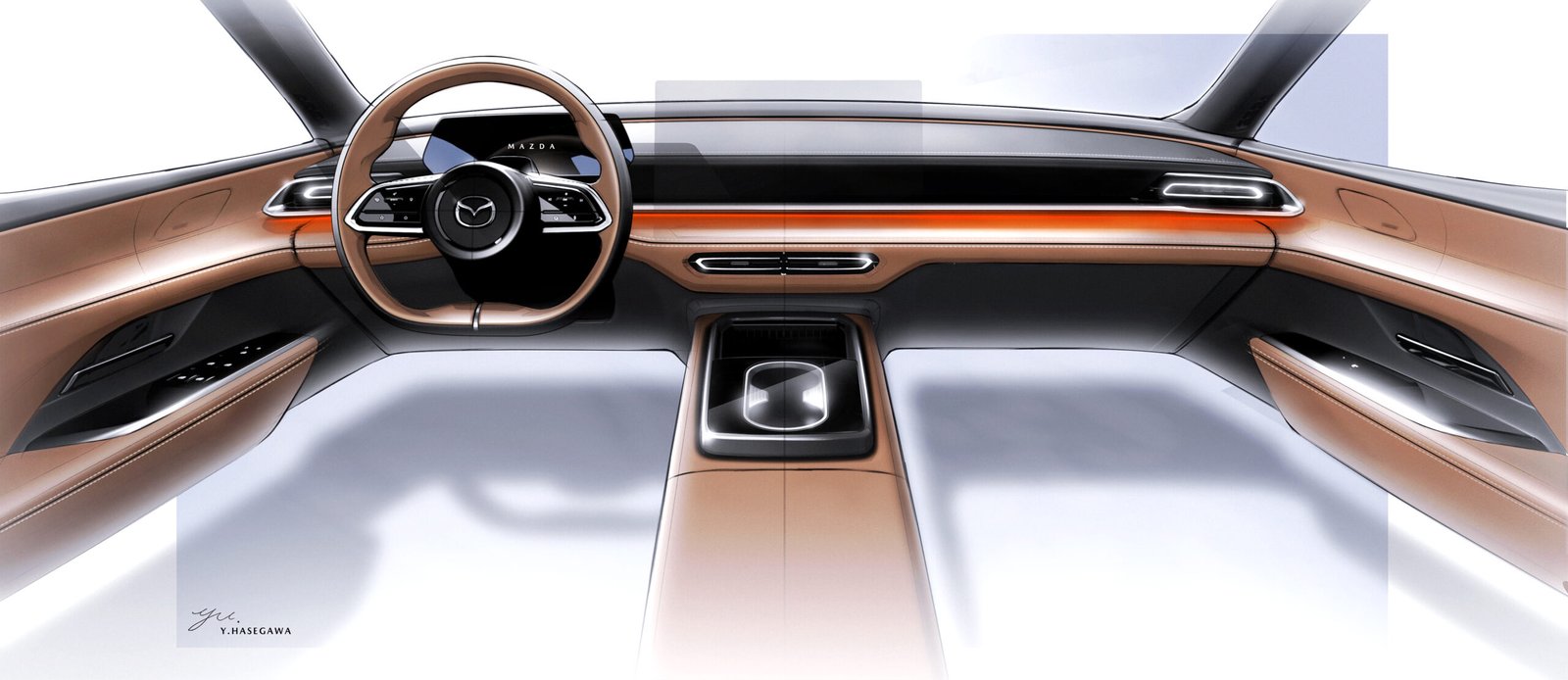
Inside, the cabin intentionally steps away from the cold, screen-centric minimalism that dominates so many modern interiors. Instead, Iwauchi prioritised driver engagement by preserving a high centre console to encapsulate both driver and passenger, as opposed to the more ubiquitous lounge-like layouts. “We divided the front seats with a high centre console, creating a cockpit that firmly wraps around the driver,” Iwauchi explains. “To give an analogy, it’s like the feeling of soaking in a deep bathtub.”

While secondary comfort controls move to the central display, primary driving metrics remain in the driver’s line of sight, via a dedicated digital instrument cluster and head-up display. “We placed necessary driving information directly in front of the driver to minimise eye movement,” Iwauchi notes. “This is so as not to compromise the feeling of unity between driver and car (Jinba Ittai).”

Iwauchi’s refusal to surrender brand identity resulted in global validation in New York, where a panel made up of 98 international journalists voted the 6e the 2026 World Car Design of the Year – Mazda’s third win in the category and proof EVs don’t all have to look the same.

“We avoided gimmicky (Azatoi) expressions or unnecessary staging of ‘EV-ness’,” Iwauchi reflects. “While providing an advanced digital experience, we pursued a design that stays close to human feeling… aware of the aesthetics of subtraction and empty space (Ma), aiming for a quiet space free of visual noise.”

Despite boasting impressive credentials like a sub-$50k entry price in Australia and a driving range of more than 500km, the Mazda 6e’s brilliance is in what it stands for. By refusing to treat electrification as an excuse for aesthetic conformity, Iwauchi and his team have proven that an electric sedan can remain recognisable. That he achieved this on a shared platform is all the more impressive.

Your next Read

Australians like to insist that we don’t really have winter. This is usually said by …

The ’90s dining scene was all about theatrics — make it bigger, flip it tableside, …

Where beauty embraces individuality, nourishment and science, sits Poets Atelier. The Australian skincare brand, co-founded …

I drove a Polestar 4 recently, my first time, massage seat and heated steering wheel …